
 March 23, 2014 / Joshua Tartakovsky, Ronnie Barkan / AlterNet - British Prime Minister David Cameron got more than he expected at the Israeli Knesset when he visited the country, receiving a cold shoulder from ultra-Orthodox and Palestinian legislators who share common interests, being the state’s most oppressed communities. Cameron’s visit to the Knesset took place on the same day that two controversial laws, the Conscription Law and the Governability Law, were finally approved following a prolonged legislative battle. As Prime Minister Netanyahu welcomed the guest of honour, the ultra-Orthodox parliamentarians left the plenary session in protest while their colleagues, Palestinian Members of the Knesset, refused to attend the event altogether. This was the culmination point of several months of heated protest over the Conscription Law which brought to the surface contradictions between Zionism and Judaism.
Hundreds of thousands of ultra-Orthodox Jews (Haredim) of all denominations took to the streets of Jerusalem to oppose the draft law several days before it passed. In a mass prayer, the worshippers-protesters declared their faithfulness to Torah study rather than to the military. United under a banner declaring that “the State of Israel is fighting against the Kingdom of Heaven,” they held signs stating that military draft is spiritual suicide. The event was not merely showcasing opposition to the law, but nothing short of a battle cry against the very legitimacy of a state that encroaches upon their spiritual autonomy and poses a danger to their religious liberty.
Under the slogan “Equality in the Burden,” both religious-Zionist Naftali Bennett and secular-Zionist Yair Lapid were elected and became the two largest coalition partners of a Haredi-free government. The campaign called for the forced conscription of the ultra-Orthodox and garnered wide support from the Israeli public. Unlike the purist Edah HaHaredit group which prohibits its members from partaking in, voting and receiving funds from the Zionist state, the Haredi rabbinical councils which called for the mass protest have their elected representatives at the Knesset. They all walked out of the plenum stating that Netanyahu is an enemy to their religion, yet this did not stop the Prime Minister from addressing Cameron in his welcoming speech by saying "David, welcome to the City of David and to the Jewish Knesset".
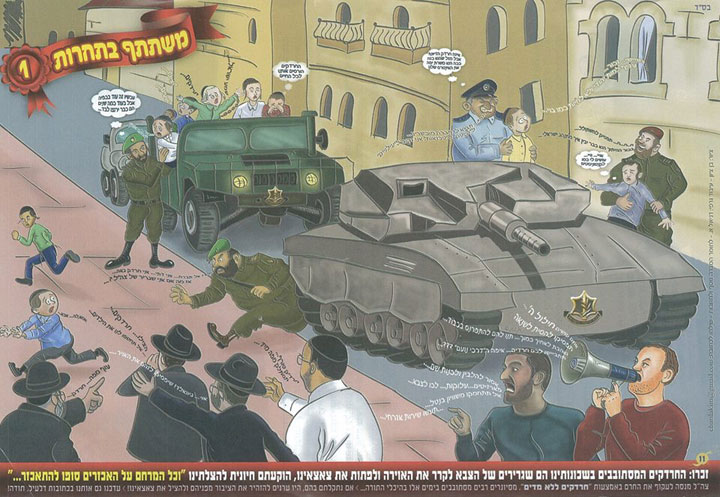
The law enforces an incrementally growing annual quota of ultra-Orthodox students to be drafted, reaching 5,200 by 2017. Religious schools that would send their students to the military will receive financial incentives but in case the goal is not met, a draft for all the ultra-Orthodox would be imposed and financial sanctions implemented. The ultra-Orthodox argue that sanctioning and criminalizing students of the Torah proves that the State of Israel cannot possibly be regarded as being Jewish. The law’s initiators, Lapid and Bennett, along with Prime Minister Netanyahu, were subsequently depicted in an animated film as they physically abuse a Haredi Jew and place him behind bars.
The National Network Opposing the Militarization of Youth (NNOMY)
Articles
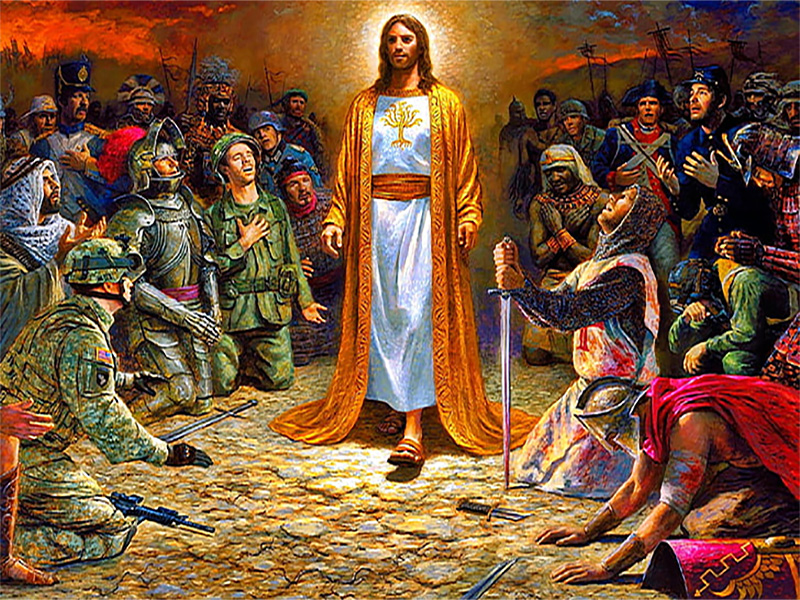 November 9, 2012 / Preston Sprinkle / Jesus Creed - Are American Evangelicals Seduced by Militarism? Is militarism consistent with Christian faith?
American militarism. The very phrase evokes a cacophony of responses from the public, not least from the American Evangelical church. It’s undeniable that America is becoming more and more militarized, as several recent books have pointed out (e.g. Andrew Bacevich, The New American Militarism; Rachel Maddow, Drift). Some Evangelicals are quick to celebrate America’s military prowess—the bigger the better—while others see it as dangerous, if not idolatrous. For reasons state in this post and the next, I believe the latter: the American Evangelical church is largely (not completely) seduced by military might.
But what is “Militarism?” According to the New Oxford American Dictionary, “Militarism” is:
[T]he belief or desire of a government or people that a country should maintain a strong military capability and be prepared to use it aggressively to defend or promote national interests.
By “militarism,” therefore, I do not mean “the people participating in the military” (I myself come from a long line of Marines), but the overarching “belief or desire” of having a strong military to protect or advance national or religious interests. Not every member of the military, as several of my military friends have told me, actually buy into the overarching agenda of militarism.
A first of its kind, "Breaking the War Habit" — focuses on the historical and contemporary role of the military’s involvement in American education.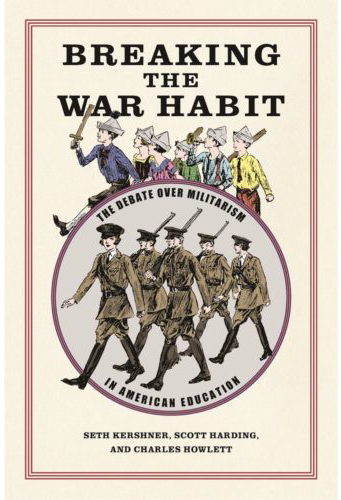 October 3, 2022 / Maynard Seider / The Berkshire Edge - At a time when bipartisan support for war and its funding has not been higher, and when any opposing sentiment earns one the label of “Putin apologist,” if not censored, a new book entitled “Breaking the War Habit” and co-authored by a Berkshire County writer, is welcome news.
A first of its kind, the book focuses on the historical and contemporary role of the military’s involvement in American education. Currently, recruiters visit some high schools as much as 100 times a school year, and military officials teach a Junior Reserve Officer Training Corp (JROTC) curriculum in more than 3,200 high schools that enroll more than 550,000 student “cadets.” Not so long ago, mandatory enrollment in ROTC at the college level was commonplace. Now, it still exists in some form in over 1,700 colleges and universities. At the same time, resistance to military programs in America’s high schools and colleges has a rich history. This history is well told by the authors.
Subtitled “The Debate Over Militarism in American Education,” the book’s lead author is Seth Kershner, a University of Massachusetts Ph.D. candidate in history from Sandisfield, and his collaborators are Scott Harding and Charles Howlett. They trace the first opposition to militarism in the country’s schools to the preeminent educational reformer, Horace Mann, who in the 1830s “insisted that schoolchildren learn that war is not heroic and demanded that history textbooks devote less attention to the subject.” In a pattern that will repeat itself well into the 20th and 21st centuries, however, the coming of war and war itself valorized military values and demanded loyalty to that end.
In fact, during the Civil War, in 1862, the government passed the Land-Grant College Act (the Morrill Act) which gave subsidies and land to state colleges with the proviso that their male students be enrolled in military training programs, the precursor of ROTC. At the same time, some high schools introduced military training programs, though federal funding for secondary level training wouldn’t become a reality until World War I.