
Every US military recruit is trained tofight and to kill and obligated to eight years of enlistment.
Ongoing conflicts today prove that deployment can happen at any time. You owe it to yourself to consider the many alternatives that do not restrict your life options. - Learn more
Parents
Enlisting in the military has been sold for generations as a way to grow up, get a start in life, maybe learn a skill and be part of a noble cause.
If you have kids today, recruiters will tell that familiar story. But today, less and less of it is true. - Learn more
Teachers and community
Based on years of experience in public schools, facilitating student organizations dealing with peace (i.e. peace clubs) in your area can have a transformative impact on student autonomy and school culture around pervasive militarism. Learn more
Who we are
TheNational Network Opposing the Militarization of Youth (NNOMY) is a network of organizations that organizes against the militarization of schools and young people in the United States.
NNOMY brings local, regional, and national peace and human rights groups together to connect youth to pathways towards meaningful lives, as alternatives to military enlistment.
"The U.S. military is deeply embedded in public schools, shaping children’s futures long before they’re old enough to understand the consequences — and parents were never meaningfully asked."
NNOMY was founded in the aftermath of the 2004 national counter-recruitment conference "Stopping War Where it Begins" in Philadelphia.[1] It is intended to be a decentralized and flexible structure that helps national, regional and local activists and organizations by promoting communication efforts and by stimulating collaboration between network members. NNOMY organizes actions and campaigns against militarism in order to raise awareness and to increase education on the topic.
February 05, 2026 / Evie Blad / Education Week - Students around the country have staged school walkouts in the last month to protest federal immigration enforcement tactics—drawing concerns about their safety from school administrators and criticism from conservative leaders opposed to their cause.
The student protests follow the killing of two civilians by federal officials in Minneapolis, where a surge of confrontational enforcement actions have attracted national attention.

16 de diciembre de 2025 / Edward Hasbrouck / Gobierno responsable – Una disposición de la NDAA de este año requerirá que el Sistema de Servicio Selectivo (SSS) encuentre una forma de hacer que el registro para el reclutamiento sea automático en lugar de permitir que los varones de 18 años se inscriban por sí mismos, lo que es la práctica actual. El SSS tendría un año para intentar elaborar una lista de todos los posibles reclutas en EE. UU. recopilando información de otras bases de datos federales. El registro automático para el reclutamiento comenzará un año después de la promulgación de la NDAA de 2026, a menos que el Servicio Selectivo sea derogado antes.
7 de febrero de 2026 / Personal de NNOMY / Red Nacional Opuesta a la Militarización de la Juventud - A principios de la década de 2000, cuando las Escuelas Públicas de Portland se alzaron brevemente como un símbolo nacional de resistencia al reclutamiento militar, el panorama político era casi irreconocible comparado con lo que enfrentan los contrarreclutadores en 2026. En aquel entonces, la lucha se centraba en la autoridad de la junta escolar para mantener a los reclutadores fuera de los pasillos y cafeterías, y los activistas encontraron una base sólida en la lógica discriminatoria de "No preguntes, no digas". La exclusión de las personas LGBTQ+ por parte de las fuerzas armadas brindó a los distritos escolares una base legal y moral clara para decir: si discriminas, no tendrás acceso a nuestros estudiantes. Era una época en la que las políticas locales aún tenían fuerza, cuando una junta escolar decidida podía establecer un límite y esperar que se mantuviera, y cuando los reclutadores dependían casi por completo de la presencia física para llegar a los jóvenes.
These are trying times. DHS agencies and the military are invading our communities. Our military is waging war or threatening war on multiple fronts.
Meanwhile, in order to maintain such an active presence on the world stage, the military needs more recruits. Recruiters are appearing at our schools, community meetings, social media, on our phones, everywhere it seems.
At the same time, the number of groups actively involved in counter military recruitment has plummeted. The National Network Opposing Militarization of Youth (NNOMY) hopes to push against that trend and spark activist groups into action. We cannot wait three years for a change. Too much is at stake.
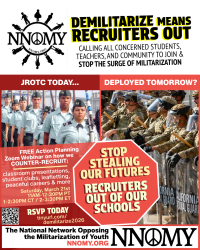
We are planning a webinar March 21 and we invite you to participate. This will be a round table discussion of ways in which you can become involved in counter recruiting. We will be talking about tabling at high schools, speaking to high school classrooms, forming peace clubs, leafleting at schools, community involvement, peaceful career opportunities, the need for social media campaigns. Each area will be presented by people that have been deeply involved in this work for a significant period.
Donald Trump—as he is wont to do during public speeches—went on one of his weird tangents. “And that plane went ‘pshh,’ like this,” he continued, diving his hand downward in an accompanying gesture. “You know, when it drops a bomb, it goes down very steeply, because that gives it a better angle, and, you know, more speed for the bomb.”
It was a characteristically glib illustration for Trump, as he narrated the experience of watching military planes drop bombs on Iran. The planes were described not in terms of the damage of their payload but rather by the sound they made as they levered inexorably downward. By now, we’re used to the way the president’s mind might lock onto something loud or shiny he sees on a screen, especially if those images provoke his enthusiasm or anger. But his play-by-play descriptions of bombs bursting in air is actually something his administration and his allies have long encouraged Americans to do: view their biggest atrocities through a gamified lens.
15 de febrero de 2026 / Personal de NNOMY / Red Nacional Contra la Militarización de la Juventud – El militarismo sobrevive no solo gracias a las armas y los presupuestos, sino también a las historias que cuenta sobre quiénes se supone que somos. Estas historias están profundamente marcadas por el género. Determinan cómo los jóvenes imaginan la adultez, cómo comprenden la fuerza, cómo interpretan el deseo y cómo deciden qué futuro les espera. En el centro de esta arquitectura narrativa se encuentra la sexualización de las mujeres: un mecanismo tan normalizado que a menudo pasa desapercibido, pero lo suficientemente poderoso como para moldear toda la lógica emocional del reclutamiento militar.
La maquinaria de reclutamiento militar depende de una versión muy específica de la masculinidad. Es una masculinidad definida por la dureza, el control emocional, la dominación física y la disposición a usar la violencia en nombre de la nación. Esto no es una consecuencia cultural accidental; es una identidad cultivada. Las campañas de reclutamiento prometen transformación: el niño inseguro se convierte en el hombre seguro de sí mismo, el joven invisible se convierte en alguien que inspira respeto, el marginado social se convierte en el protector admirado. La institución se presenta como una forja de hombría, y la imaginería que la rodea refuerza esta promesa constantemente.
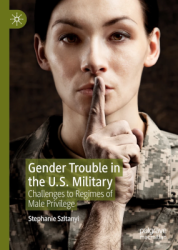
February 15, 2026 / NNOMY staff / The National Network Opposing the Militarization of Youth - Militarism survives not only through weapons and budgets, but also through the stories it tells about who we are supposed to be. These stories are deeply gendered. They determine how young people imagine adulthood, how they understand strength, how they interpret desire, and how they decide what future awaits them. At the heart of this narrative architecture is the sexualization of women: a mechanism so normalized that it often goes unnoticed, yet powerful enough to shape the entire emotional logic of military recruitment.
The military recruitment machine relies on a very specific version of masculinity. It is a masculinity defined by toughness, emotional control, physical dominance, and a willingness to use violence in the name of the nation. This is not an accidental cultural consequence; it is a cultivated identity. Recruitment campaigns promise transformation: the insecure boy becomes the self-assured man, the invisible youth becomes someone who inspires respect, the social outcast becomes the admired protector. The institution is presented as a forge of manhood, and the imagery surrounding it constantly reinforces this promise.
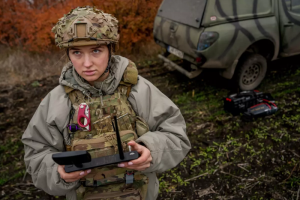
February 09, 2026 / NNOMY staff / The National Network Opposing the Militarization of Youth - When the war in Ukraine erupted into global headlines, many young people in the United States saw images of drones buzzing over trenches, soldiers coordinating attacks through phone apps, and cyber teams defending entire cities from digital sabotage. It looked like a different kind of war—high‑tech, fast‑moving, and unpredictable. What’s less visible is how closely the U.S. military has been watching these developments, and how the lessons drawn from Ukraine are now shaping the strategies, budgets, and recruitment messages aimed at American youth.
9 de febrero de 2026 / Personal de NNOMY / La Red Nacional Contra la Militarización de la Juventud - Cuando la guerra en Ucrania irrumpió en los titulares internacionales, muchos jóvenes en Estados Unidos vieron imágenes de drones sobrevolando trincheras, soldados coordinando ataques mediante aplicaciones móviles y equipos cibernéticos defendiendo ciudades enteras del sabotaje digital. Parecía una guerra diferente: de alta tecnología, rápida e impredecible. Lo que es menos visible es la estrecha vigilancia del ejército estadounidense sobre estos acontecimientos y cómo las lecciones aprendidas en Ucrania están moldeando las estrategias, los presupuestos y los mensajes de reclutamiento dirigidos a la juventud estadounidense.