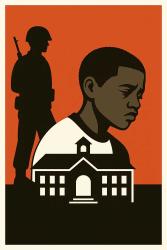
Every US military recruit is trained tofight and to kill and obligated to eight years of enlistment.
Ongoing conflicts today prove that deployment can happen at any time. You owe it to yourself to consider the many alternatives that do not restrict your life options. - Learn more
Parents
Enlisting in the military has been sold for generations as a way to grow up, get a start in life, maybe learn a skill and be part of a noble cause.
If you have kids today, recruiters will tell that familiar story. But today, less and less of it is true. - Learn more
Teachers and community
Based on years of experience in public schools, facilitating student organizations dealing with peace (i.e. peace clubs) in your area can have a transformative impact on student autonomy and school culture around pervasive militarism. Learn more
Who we are
TheNational Network Opposing the Militarization of Youth (NNOMY) is a network of organizations that organizes against the militarization of schools and young people in the United States.
NNOMY brings local, regional, and national peace and human rights groups together to connect youth to pathways towards meaningful lives, as alternatives to military enlistment.
"The U.S. military is deeply embedded in public schools, shaping children’s futures long before they’re old enough to understand the consequences — and parents were never meaningfully asked."
NNOMY was founded in the aftermath of the 2004 national counter-recruitment conference "Stopping War Where it Begins" in Philadelphia.[1] It is intended to be a decentralized and flexible structure that helps national, regional and local activists and organizations by promoting communication efforts and by stimulating collaboration between network members. NNOMY organizes actions and campaigns against militarism in order to raise awareness and to increase education on the topic.
Books about counter military recruitment activism are a rich landscape to draw from. Based on a search about counter military recruitment and the broader field of anti-militarist organizing, here’s a curated, well-organized list of books directly about counter-recruitment activism, plus a few adjacent works that have become staples in the movement.
Sin embargo, también entendemos que NO hay prohibiciones por parte de la escuela y su junta directiva para implementar medidas contra el reclutamiento militar.
December 22, 2025 / National Network Opposing the Militarization of Youth - In a time when the United States is increasingly seen as a militarized force shaping global instability, peace advocates are turning their attention to the places where the next generation is being quietly funneled toward war. Across campuses, community centers, and public events, small groups of organizers are meeting students face‑to‑face, offering a different path than the one recruiters present. Their approach is simple: honest conversations about what militarization means — not just abroad, but at home. They talk about how foreign policy decisions ripple into classrooms, neighborhoods, and futures. They share information about alternatives to enlistment, from apprenticeships and civilian service programs to local organizing efforts that strengthen communities instead of sending young people into conflict.
A medida que Estados Unidos se convierte en una amenaza cada vez más militarizada para el orden internacional, los grupos por la paz están recurriendo a los estudiantes para contra-reclutamiento y resistir la guerra como forma de avanzar.
Dec 16, 2025 / Edward Hasbrouck / Responsible Statecraft - A provision in this year’s NDAA will require the Selective Service System (SSS) to find a way to make registering for the draft automatic instead of letting 18-year-old males sign up themselves, which is current practice. The SSS would have a year to try to construct a list of all potential draftees in the U.S. by pooling information from other Federal databases. “Automatic” draft registration will start a year after the 2026 NDAA is signed into law, unless the Selective Service is repealed before then. This doesn’t mean that a draft is being activated right away, or that those registered will be sent induction orders — although preparing to do so is the sole purpose of making this list. This will, however, be the largest change in Selective Service law since 1980, and will move the U.S. closer to activation of a draft than at any time in the last half century. To be sure, “automatic” registration is a response to a growing recognition that the current system is an abject failure in the face of pervasive noncompliance.
Few young men register voluntarily with the SSS, and almost none of them report their new addresses to the SSS each time they move. As a result, the current database is so incomplete and inaccurate that it would be “less than useless” for an actual draft, according to Bernard Rostker, who was Director of the Selective Service System from 1979-1981, testifying in 2019.The obvious congressional response would be to end the registration program and abolish the Selective Service System as a failure and unfit for its stated purpose, even if one supports a draft.
December 8, 2025 / Rebecca Kheel / Roll Call - Young men are set to be automatically registered for the draft under the compromise version of the fiscal 2026 National Defense Authorization Act unveiled Sunday night. The automatic draft registration provision was one of several measures included in the bill that broadly aim to make it easier for the military to find young people at a time when the propensity to serve remains low. The U.S. has not drafted anyone into compulsory military service since 1973, but young men still have to register with the Selective Service System in case there is a draft again in the future. Failing to register is a felony punishable by a fine of up to $250,000 and five years imprisonment, as well as a loss of eligibility for federal jobs and, in most states, state student aid and state jobs.
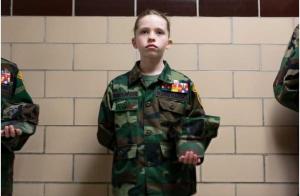
December 1, 2017 / Alexa Keefe / Photographs: Sarah Blesener / National Geographic - Over the past year, photographer Sarah Blesener has been visiting patriotic youth groups around the country, from teens being trained as border guards in Texas, ROTC chapters in New York, a patriotic church camp in Utah, and a young woman in Nebraska preparing to head to the military once she graduates from high school. Her aim has been to explore how different combinations of religion, love of country, and military-style training come together in the teaching of “new Americanism,” which Blesener defines as a renewed embrace of the centuries-old theme of American exceptionalism and manifest destiny.