

Every US military recruit is trained tofight and to kill and obligated to eight years of enlistment.
Ongoing conflicts today prove that deployment can happen at any time. You owe it to yourself to consider the many alternatives that do not restrict your life options. - Learn more
Parents
Enlisting in the military has been sold for generations as a way to grow up, get a start in life, maybe learn a skill and be part of a noble cause.
If you have kids today, recruiters will tell that familiar story. But today, less and less of it is true. - Learn more
Teachers and community
Based on years of experience in public schools, facilitating student organizations dealing with peace (i.e. peace clubs) in your area can have a transformative impact on student autonomy and school culture around pervasive militarism. Learn more
Who we are
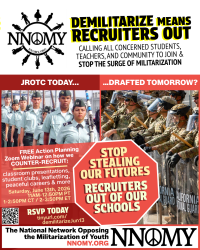
TheNational Network Opposing the Militarization of Youth (NNOMY) is a network of organizations that organizes against the militarization of schools and young people in the United States.
NNOMY brings local, regional, and national peace and human rights groups together to connect youth to pathways towards meaningful lives, as alternatives to military enlistment.
"The U.S. military is deeply embedded in public schools, shaping children’s futures long before they’re old enough to understand the consequences — and parents were never meaningfully asked."
NNOMY was founded in the aftermath of the 2004 national counter-recruitment conference "Stopping War Where it Begins" in Philadelphia.[1] It is intended to be a decentralized and flexible structure that helps national, regional and local activists and organizations by promoting communication efforts and by stimulating collaboration between network members. NNOMY organizes actions and campaigns against militarism in order to raise awareness and to increase education on the topic.
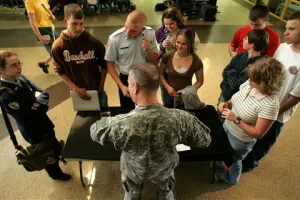
May, 14, 2026 / NNOMY Administration / National Network Opposing the Militarization of Youth - These are trying times. DHS agencies and the military are invading our communities. Our military is waging war or threatening war on multiple fronts. Meanwhile, in order to maintain such an active presence on the world stage, the military needs more recruits. Recruiters are appearing at our schools, community meetings, social media, on our phones, everywhere it seems.
24 de abril de 2026 / Rubicon & Griobhtha y Juan Idalgo / Cruzando Rubicons - La Primera Guerra Mundial, la “Guerra para acabar con todas las guerras”, mató a entre 30 y 40 millones de personas. La versión 2.0 de la “Guerra para acabar con todas las guerras” mató al doble. Desde 1945, Estados Unidos ha matado a aproximadamente 20 millones de personas en todo el mundo mediante matanzas directas. Corea mató a millones, en su mayoría civiles inocentes; Vietnam mató a millones más, también en su mayoría civiles inocentes. Si se añaden las guerras subsidiarias, las sanciones, la hambruna deliberada de poblaciones y la retención de medicamentos y atención médica (“para darles una lección”), la cifra, de forma conservadora, alcanza los 45-50 millones de personas exterminadas agresivamente. Si se incluyen las demás potencias coloniales occidentales, las cifras se duplican de nuevo.
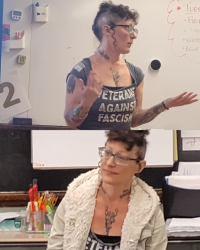
03 de mayo de 2026 / Joy Damiani / No somos tus soldados -“¿Cómo se quedan sin hogar los veteranos?” Es una pregunta que no debería hacerse en una sociedad sana. Cuando un adolescente me lo dirigió en una escuela en el corazón de Manhattan, dijo mucho del mundo que los estudiantes están a punto de heredar. No sólo están presenciando y experimentando horrores en todas direcciones, sino que tienen alarmantemente poca información sobre lo que les deparará el futuro, y menos aún sobre el ejército.
Aug. 30, 2008 / Associated Press / The Gainesville Sun - WILKESBORO, N.C. – Sally Ferrell bounded from the truck and grabbed a posterboard sign that read: "War is not the Answer."
Over the years, she's organized dozens of peace vigils like this one being set up in a parking lot. Find common ground, she has always preached, and any conflict can be resolved.
But she's now engaged in a conflict of her own — a dispute over military recruiting in high schools that has polarized rural Wilkes County.
For three years, Ferrell has asked permission to distribute pamphlets and other materials that warn students to think twice before joining the military. But the school superintendent has stopped her, calling her activities unpatriotic. The American Civil Liberties Union, calling it a First Amendment issue, has threatened to sue.
Apr 24, 2026 / Rubicon & Griobhtha, and Juan Idalgo / Crossing Rubicons - World War 1, the “War to end all wars” killed 30-40 million people. Version 2.0 of the “War to end all wars” killed double that. Since 1945, the United States has killed approximately 20 million people around the globe through direct slaughter. Korea killed millions, mostly innocent civilians, Vietnam killed millions more, mostly innocent civilians. When you add in proxy wars, sanctions, deliberate starvation of populations and withholding of medicine and care (“to teach them a lesson”), the number conservatively reaches 45-50 million aggressively culled. When you add in the other Western colonial powers, the figures double again.
March 20, 2026 / Emily Graham - For busy parents tracking Middle East issues while juggling work, school schedules, and everyday responsibilities, it can be hard to notice when concern turns into parental anxiety that follows everyone into the room. The core tension is real: staying informed can feel responsible, yet the stress can quietly color conversations, patience, and routines in ways kids absorb. Anxiety effects on children often show up indirectly, so even “normal” days can carry a heavier emotional tone than intended. Recognizing the parental anxiety impact is the first step toward protecting children’s emotional well-being and supporting family mental health.
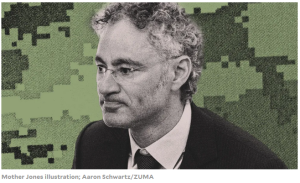
April 20, 2026 / Sophie Hurwitz / Mother Jones MoJo Wire - On Sunday afternoon, Palantir, the defense-tech company that sells software to clients like ICE, the US military, and the Israeli military, decided to give us all a piece of their mind. The company’s official X account published a list of excerpts from co-founder Alex Karp’s 2025 book The Technological Republic.
The book frames Silicon Valley’s move into military technology as the righteous repayment of a “moral debt” owed to the country that built the tech billionaire class. “The engineering elite of Silicon Valley has an affirmative obligation to participate in the defense of the nation.”
April 18, 2026 / NNOMY Staff / National Network Opposing the Militarization of Youth (NNOMY) - For more than two decades, counter‑military recruitment has been one of the most persistent forms of peace activism in the United States. It has survived political cycles, funding droughts, shifting school policies, and the rise of digital recruitment. Yet the heart of the work has remained constant: protecting young people’s right to a future that is not defined by economic desperation or military necessity. What has changed is the world young people are inheriting — and the strategies required to meet them where they are.
El libro X Rubicón: Cruzando la vida, el sexo, el amor y asesinatos en las guerras por poderes de la CIA: Una acusación contra ciudadanos estadounidenses: ignorantia non excusat de Sean Griobhtha irrumpe como una voz insistente que se abre paso entre el ruido que rodea a las y los jóvenes reclutados por el ejército estadounidense. El libro “funciona al desestabilizar las ideas preconcebidas del lector”, negándose a ofrecer conclusiones fáciles o la comodidad ideológica habitual. En cambio, invita al publico lector —especialmente a quienes que se encuentran en el umbral de la adultez— a confrontar la incómoda verdad de que la participación en grandes instituciones, particularmente aquellas construidas en torno a la violencia organizada, es inseparable de las consecuencias que dichas instituciones producen.
Sean Griobhtha’s X Rubicon: Crossing Life, Sex, Love, & Killing in CIA Proxy Wars: An indictment of US Citizens: ignorantia non excusat enters like an insistent voice cutting through the noise that surrounds young people targeted by U.S. military recruitment. The book “works by unsettling the reader’s assumptions,” refusing to offer easy conclusions or familiar ideological comfort. Instead, it invites readers—especially those standing at the threshold of adulthood—to confront the uncomfortable truth that participation in large institutions, particularly those built around organized violence, cannot be separated from the consequences those institutions produce.