
Conscience as Resistance: Grinding the Recruitment Machine to a Necessary Halt
español - Authors: Sean Griobhtha, Jules Bond
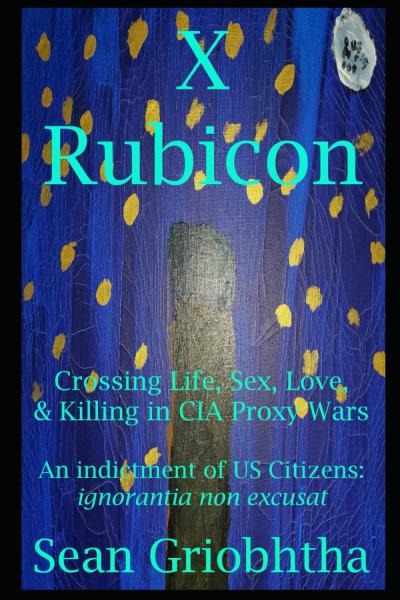
 Sean Griobhtha’s X Rubicon: Crossing Life, Sex, Love, & Killing in CIA Proxy Wars: An indictment of US Citizens: ignorantia non excusat enters like an insistent voice cutting through the noise that surrounds young people targeted by U.S. military recruitment. The book “works by unsettling the reader’s assumptions,” refusing to offer easy conclusions or familiar ideological comfort. Instead, it invites readers—especially those standing at the threshold of adulthood—to confront the uncomfortable truth that participation in large institutions, particularly those built around organized violence, cannot be separated from the consequences those institutions produce.
For youth navigating economic insecurity, limited educational pathways, and the relentless optimism of recruiters promising transformation, X Rubicon becomes a kind of intellectual friction. It slows the momentum that often carries them toward enlistment before they have fully examined what they are stepping into. Griobhtha’s refusal to let distance become an alibi is central to this effect. In a world where war is increasingly mediated by screens, algorithms, and remote technologies, he insists that “pressing a button is still an act, following orders is still a choice,” a reminder that the moral weight of an action does not diminish simply because the actor is far from the harm.
The book also speaks directly to the emotional landscape of 2026 youth. Many are not drawn to enlistment out of patriotic fervor but out of exhaustion—from debt, instability, and the sense that civilian life offers no stable foothold. Griobhtha acknowledges this desperation with empathy while refusing to let it be exploited. The text “gives language to the quiet unease many young people already feel,” naming the dissonance between their desire for purpose and the reality of institutions that may use that desire for ends they never intended. In this way, X Rubicon becomes not a lecture but a companion, walking with the reader as they confront what responsibility truly means.
For counter‑recruitment advocates, the significance of this cannot be overstated. The book does not tell young people what to think; it teaches them how to think in a way that makes unexamined enlistment far less likely. It cultivates moral agency at a moment when institutional narratives are designed to narrow it. In a year when federal policy expands recruiter access to schools and lowers enlistment standards to meet quotas, X Rubicon becomes a quiet but powerful form of resistance.
Philosophically, the book is anchored by the provocation that ignorance is not an excuse. As the document states, the subtitle’s Latin tag—ignorantia non excusat—is “the spine.” Griobhtha constructs an extended indictment not only of the CIA, Pentagon, or VA, but of ordinary U.S. citizens whose distance from proxy wars in El Salvador, Guatemala, and Nicaragua has allowed them to pretend they are uninvolved. The narrative of a single combat veteran becomes a case study in how individual agency is braided into institutional violence. In this sense, the book stands in the lineage of thinkers like Karl Jaspers and Hannah Arendt, who distinguish between legal guilt and moral responsibility.
Politically, X Rubicon challenges U.S. exceptionalism and the mythology of “clean” foreign policy. By focusing on CIA proxy wars rather than conventional conflicts, Griobhtha exposes the shadow architecture of American power—the deniable operations, outsourced killing, and plausible deniability that allow the public to sleep at night. The indictment is not abstract; it is tied to propaganda, media silence, and the way electoral politics rarely reckon with the human cost of these operations. The book is not just anti‑war; it is anti‑amnesia.
Narratively, Griobhtha uses intensity as a method. The book is “raw, unfiltered, emotionally jarring,” a deliberate counter to the smoothing language of official reports and patriotic storytelling. The personal connection between author and subject, the inclusion of a redacted ODNI letter, and the detailed recounting of operations and PTSD collapse the distance between reader and subject. The veteran’s trauma becomes a symptom of a society that demanded his violence and then abandoned him. Stylistically, the book belongs alongside works like The Things They Carried, but with a sharper prosecutorial edge.
Within the tradition of moral‑responsibility literature, X Rubicon widens the circle of responsibility beyond soldiers and policymakers to include the citizen‑spectator. This is what makes the book so relevant to recruitment‑age youth: it reframes the choice not as “to enlist or not,” but as “to remain willfully ignorant or to confront what your society is doing.” For NNOMY and similar organizations, this is both powerful and dangerous—powerful because it arms youth with a deep ethical framework, dangerous because once they cross that X Rubicon of awareness, they cannot return to the comfort of not knowing.
In counter‑recruitment workshops, X Rubicon behaves less like a pamphlet and more like an encounter. It destabilizes the comfortable distance many youth maintain between themselves and the consequences of U.S. military action. The book’s intensity becomes a pedagogical strength, helping young people understand that enlistment is not simply a career choice but a moral crossing. It bridges personal experience and structural analysis, revealing how institutions exploit economic pressure, family expectations, and the longing for purpose.
Perhaps its greatest contribution is the way it restores the pause. Recruiters are trained to move quickly, to keep conversations focused on benefits and identity. X Rubicon slows everything down. It invites youth to sit with discomfort, to question narratives that once felt solid, and to imagine themselves as moral actors rather than passive participants in a predetermined path. Once that pause exists, facilitators can help youth explore alternatives without the pressure of a recruiter’s script.
Ultimately, X Rubicon transforms awareness into agency. It opens a door that cannot easily be closed. Once a young person has glimpsed the complexity behind the uniform and the consequences behind the rhetoric, they cannot return to the simplicity of “I didn’t know.” That irreversible shift is precisely why the book is so powerful in counter‑recruitment spaces, and why it deserves a central place in the activist toolkit.
- NNOMY staff
$ Purchase from the author's website from multiple sources and available in ebook, paperback, and hardcover

Please consider supporting The National Network Opposing the Militarization of Youth
and our work to demilitarize our schools and youth by sending a check to our fiscal sponsor "in our name" at the
Alliance for Global Justice.
Donate Here
###
Updated on 4/15/2026 - NS