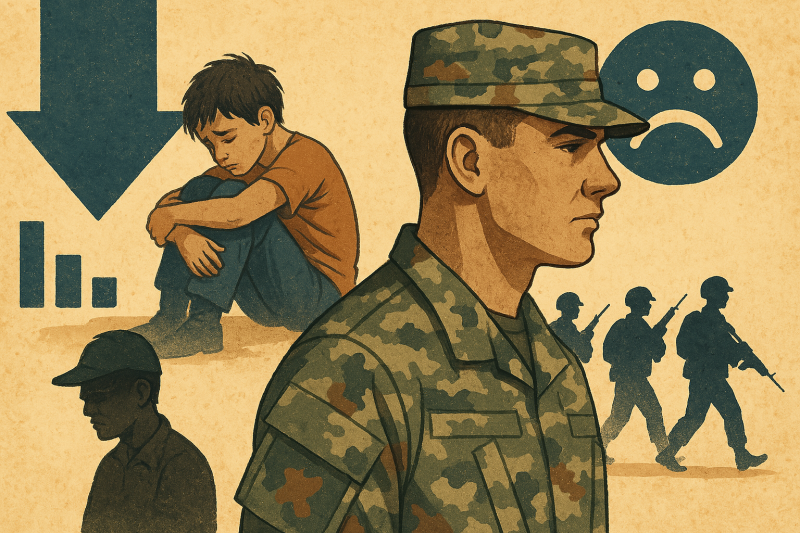
Men raised in poverty had greater odds of draft and all-volunteer military service. Early-life experiences, independent of military service, appear associated with greater odds of Major Depression. Assessing childhood poverty in service members may identify risk for depression in later life.
español -
 Natalie Bareis / Briana Mezuk / Journal of Affective Disorders / NIH - Major Depression (MD) is the most common psychiatric disorder among middle-age and older adults, affecting between 15% and 20% of this population (Aldrich, 2016; Diefenbach and Goethe, 2006). MD is associated with premature mortality from lack of self-care, diminished functioning, and suicide (Fiske et al., 2009). There is a growing body of research that indicates mental health in middle age and later-life is influenced by exposures experienced much earlier in the life course, including in childhood. For example, adverse childhood experiences (ACEs), such as experiencing neglect and abuse, are associated with MD in adults across the lifespan (Culpin et al., 2015). Even less severe exposures such the experience of poverty early in life have been associated with depression in older adults (Johnson et al., 1999).
Childhood poverty is also associated with entrance into military service. Prior research indicates that individuals who experienced poverty and other ACEs in childhood are more likely to enroll in military service (at least in the all-volunteer era (Segal et al., 1998)), with Blosnich et al. (2014) hypothesizing “that the military may serve as a route for a subset of persons to escape dysfunctional home environments, at least among men.” (p. E4). It is also notable that the racial make-up of the military has changed substantially over time, becoming more racially-diverse in recent decades (2014 Demographics: Profile of the Military Community, 2014; Barnes et al., 2013). Thus, military service may provide a pathway out of poverty, ultimately altering individuals’ mental and physical health trajectories (Chatterjee et al., 2009).
However, military service also puts individuals at risk of exposure to combat and other types of trauma, exposures that have established negative relationships with MD and other forms of psychopathology in later life (Cabrera et al., 2007; Conner et al., 2014; Hoge et al., 2004). For example, studies of identical twins who both served in the military during the Vietnam War have shown combat exposure is associated with later risk of post-traumatic stress disorder many years after service ends (Goldberg et al., 1990; Koenen et al., 2002). In sum, the long term implications of childhood poverty and military service on MD is poorly understood. Extant studies have been limited in scope (i.e., use of non-representative samples; have not examined specific elements of military service history; have relied on non-specific measures of psychological distress) (Blosnich et al., 2014; Montgomery et al., 2013).
The goal of this study is to examine the relationships between childhood poverty and military service with MD in a nationally-representative sample of older men using data from the Health and Retirement Study. The objectives of this analysis are to: 1) Examine the relationship between childhood poverty and MD; 2) Examine the relationship between military service and MD; and 3) Assess whether the relationship between childhood poverty and MD is mediated or moderated by history of military service among men. We hypothesized that the relationship between childhood poverty and MD would be partially mediated by history of military service. If that is the case then the relationship between childhood poverty and MD will be reduced, but still significant after controlling for history of military service.
2.1. Sample
Data come from the 2010 Wave of the Health and Retirement Study (HRS). The HRS is an ongoing, longitudinal, nationally-representative multistage area probability sample of adults over age 50 with a steady-state sample size of approximately 20,000 individuals. It includes oversampling of African Americans, Hispanics and Floridians. Institutionalized individuals are initially excluded from the study, but participants are followed when they move from the household population into institutions. The cohort is re-interviewed every two years, and is refreshed every six years with an additional younger age group (over age 50) to keep the HRS representative of the aging US population, most recently in 2010. Starting in 2008, all HRS respondents were assessed for past-year MD using the Composite International Diagnostic Inventory Short Form (CIDI-SF) Depression Module (Kessler et al., 1998). The response and follow-up rates for the HRS range from 85% to 95% (Health and Retirement Study: Sample sizes and response rates, 2011). The 2010 respondent weights used in these analyses excludes individuals who were residing in nursing homes and corrects for attrition due to death or non-response. Importantly, health status and indicators of socioeconomic status (educational attainment, wealth) are not significant predictors of attrition in the HRS (Banks et al., 2011). Further details of the HRS design and methods can be found elsewhere (Growing older in America: The Health and Retirement Study, 2007; Health and Retirement Study: Sample sizes and response rates, 2011).
The analytic sample for this study was restricted to men who had complete data from the 2010 CIDI-SF MD module, childhood poverty measures, and military service history, including years of entrance or exit from the military for those who served. Individuals missing data on at least one of the childhood poverty measures were excluded from the analysis using listwise deletion (N = 1722 excluded who had information on all other measures used in this study (i.e., depression, military service)). Only men were included because few women in this cohort had served in the military, and none served in combat.
The HRS is approved by the Institutional Review Board at the University of Michigan and all respondents provided informed consent. This analysis is exempt because the data are publicly available.
2.2. Measures
2.2.1. Outcome: major depression
Past year MD was assessed by the CIDI-SF administered to all respondents in 2010. The CIDI-SF is a fully-structured diagnostic interview that operationalizes the diagnostic criteria of the Diagnostic and Statistical Manual of Mental Disorders Fourth Edition Text Revision (DSM-IV-TR (Diagnostic and statistical manual of mental disorders, 2000)). The CIDI-SF is administered by trained lay interviewers, and has moderate concordance with clinical interviews (Kessler et al., 1998).
2.2.2. Exposure: childhood poverty
Childhood poverty was defined by four self-report variables asking about the respondents’ families when they were growing up (specified as up to age 16): 1) “Would you say your family during that time was pretty well off financially, about average, or poor?” The four possible responses were dichotomized as Poor (including “Poor” and “It varied”) and Not Poor (including “Pretty well off financially” and “About Average”); 2) “Did financial difficulties ever cause you or your family to move to a different place?” which was recorded as a dichotomous variable (yes/no); 3) “Was there a time when you or your family received help from relatives because of financial difficulties?” which was also recorded dichotomously as yes/no; and 4) “Was there a time of several months or more when your father had no job?” which was also dichotomously recorded as yes/no. These four variables were examined as independent predictors as well as a count (ranging from 0 to 4) of the number of childhood poverty indicators experienced.
2.2.3. Potential mediator: military service
Military service was defined using three variables indicating history of military service and dates of entry and exit from the military. The primary variable was a dichotomous indicator of whether the respondent had ever served in the “active military” (yes/no). Dates of entry and exit from the military were used to determine whether the respondent entered the military in the draft-era (prior to 1973) or all-volunteer era (1973 to present). Previous studies have found that poverty is associated with entrance into the all-volunteer military (Blosnich et al., 2014). Therefore, these latter two variables were used as part of a sensitivity analysis to examine whether the relationship between childhood poverty and military service varied during these different service eras in this sample.
2.2.4. Other characteristics
Demographic characteristics included age (in years), race/ethnicity (categorized as White, African American, and Hispanic/Other), education (categorized as less than high school, high school, some college, and college graduate or more) and marital status (categorized as currently married/partnered; formerly married, including separated, divorced, and widowed; and never married).
Finally, because screening procedures often preclude individuals with a history of psychopathology from military service (Jones et al., 2003), as an exploratory sensitivity analysis we analyzed self-reported history of childhood mental illness, indicated by history of depression, drug or alcohol problems, and any other emotional/psychological problems prior to age 16, as a covariate in the descriptive analyses.
2.3. Analysis
Two conceptual models – mediation and moderation – of the relationships between childhood poverty, military service, and MD were evaluated. We conducted these analyses for each of the four indicators of childhood poverty separately, the summary count of childhood poverty indicators (none to four), and across the two indicators of military service (i.e., any military service vs. civilian using the entire sample; and service during the draft vs. service during the all-volunteer era restricted to only those with a history of any military service). We evaluated these models using logistic regression, accounting for the complex sampling design of the HRS, and all models were adjusted for age, race, educational attainment and marital status. All analyses were conducted using SAS 9.3 and all p-values refer to two-tailed Wald Chi-Square tests.
2.3.1. Mediation model
First, we examined the three direct relationships between the exposure (childhood poverty), potential mediator (military service) and the outcome (MD) (Supplemental Figure 1). If these three paths were statistically significant, it would indicate that military service is a potential mediator of the relationship between childhood poverty and MD. To examine this hypothesis specifically, a final model was fit to test whether the relationship between childhood poverty and MD was attenuated after accounting for military service. The difference (change-in-estimate, CIE) between the coefficient of childhood poverty on MD from the first model and this mediation model would indicate the degree to which military service mediates this relationship; a 10% CIE is consistent with at least partial mediation (Grayson, 1987). CIE was used as a more strict measure of mediation.
2.3.2. Moderation model
To evaluate whether the relationship between childhood poverty and MD varied as a function of military service, another model was fit with an interaction term between the childhood poverty indicators and military service measures (Supplemental Figure 1). A positive coefficient and statistically significant interaction term would indicate that military service exacerbated the relationship between childhood poverty and MD.
Table 1 describes the characteristics of the analytic sample by history of military service. Approximately 4 in 10 men had a history of military service, of which over 86% served during the draft era. One in five men reported at least one indicator of childhood poverty, and over 9% experienced three or more poverty indicators. Among veterans, 57% of those serving in the all-volunteer era reported no poverty indicators as compared to 50% of those from the draft era; however a greater proportion from the all-volunteer era reported four or more indicators of poverty (4.8% vs. 3.5%, respectively, χ2 = 12.02, df = 4, p = 0.02). Approximately 12% of respondents met criteria for past-year MD; among veterans, the prevalence of MD was higher among those who served in the all-volunteer era as compared to the draft era (23.5% vs. 8.3%, respectively, χ2 = 48.71, df = 1, p<0.01). Finally, consistent with the notion that screening procedures would select a healthier population for military service, history of psychiatric illness in childhood was extremely uncommon among men with a history of military service, both in the draft and all-volunteer eras, (Childhood Depression (unweighted sample size and weighted percent): N = 28, 1.96% and N = 18, 6.52%; Childhood Alcoholism: N = 8, 0.59% and N = 11, 4.82%; Childhood Other Psychiatric Illness: N = 28, 1.63% and N = 12, 5.15% respectively) (Jones et al., 2003; Leavitt, 1946; Morabia and Zhang, 2004).
Table 1.
Demographic characteristics of the sample by Military Service Categories.
| All Males | Civilian | Militaryd |
||
|---|---|---|---|---|
| Draft Era (<1973) (N, % of Military) | All-Volunteer (≥1973) (N, % of Military) | |||
| Males (N, %) | 6330 | 3582 (59.30) | 2442 (86.26) | 306 (13.74) |
| Age Mean (SE) | 64.59 (0.33) | 61.04 (0.29) | 72.29 (0.27) | 53.91 (0.26) |
| Race (N, %) | ||||
| White | 4718 (83.43) | 2454 (80.20) | 2112 (90.48) | 152 (73.40) |
| African American | 1139 (10.30) | 734 (11.15) | 275 (7.48) | 130 (19.05) |
| Other | 473 (6.27) | 394 (8.66) | 55 (2.04) | 24 (7.54) |
| Education (N, %) | ||||
| LT HS and GED | 1541 (19.80) | 1060 (22.72) | 443 (16.11) | 38 (11.91) |
| High School Graduate | 1682 (25.89) | 898 (24.03) | 696 (28.60) | 88 (28.56) |
| Some College | 1478 (23.89) | 735 (22.14) | 627 (25.21) | 116 (34.15) |
| College and Above | 1629 (30.42) | 889 (31.11) | 676 (30.08) | 64 (25.38) |
| Marital Status (N, %) | ||||
| Currently Married | 4793 (74.14) | 2691 (73.93) | 1894 (75.17) | 208 (69.97) |
| Formerly Married | 1198 (18.60) | 637 (17.55) | 493 (20.35) | 68 (18.74) |
| Never Married | 339 (7.26) | 254 (8.53) | 55 (4.48) | 30 (11.29) |
| Late Life MD (N, %) | 683 (11.49) | 415 (12.22) | 204 (8.34) | 64 (23.47) |
| Childhood Mental Illness | ||||
| Depression (N, %)a | 129 (2.61) | 83 (2.52) | 28 (1.96) | 18 (6.52) |
| Alcohol and Substance Use (N, %)b | 72 (1.49) | 53 (1.57) | 8 (0.59) | 11 (4.82) |
| Other Psychiatric Illnesses (N, %)c | 102 (2.28) | 62 (2.29) | 28 (1.63) | 12 (5.15) |
| Childhood Poverty | ||||
| Father Unemployed (N, %) | 1252 (18.91) | 627 (16.74) | 575 (22.96) | 50 (16.51) |
| Move Due to Finances (N, %) | 1165 (16.72) | 596 (14.59) | 504 (19.62) | 65 (21.18) |
| Low SES (N, %) | 2045 (28.63) | 1099 (26.59) | 845 (32.17) | 101 (27.93) |
| Extended Family Help (N, %) | 953 (14.19) | 504 (12.83) | 376 (15.13) | 73 (22.81) |
| Childhood Poverty Counts (N, %) | ||||
| None | 3294 (55.82) | 1964 (59.16) | 1168 (49.97) | 162 (57.10) |
| One Criterion | 1503 (21.97) | 824 (20.86) | 617 (24.68) | 62 (16.68) |
| Two Criteria | 867 (12.78) | 463 (11.98) | 370 (14.29) | 34 (11.70) |
| Three Criteria | 486 (6.82) | 248 (6.08) | 205 (7.60) | 33 (9.74) |
| Four Criteria | 180 (2.62) | 83 (1.92) | 82 (3.46) | 15 (4.78) |
Values are Unweighted N and Weighted %, or Weighted Mean and SE, as indicated.
N = 5268.
N = 5275.
N = 5273.
N = 2748 (40.70% of All Males), values represent within Military among those with any Military service; Draft Era ended in 1973.
Table 2 shows the results of the multiple logistic regression analyses. All indicators of childhood poverty were associated with elevated odds of MD. There was a dose-response relationship between the count of poverty indicators and relative odds of MD. For example, relative to those with no poverty indicators, those with four indicators had 2.4 times greater odds of MD (95% Confidence Interval (CI): 1.32–4.32). Next, we tested the relationships between childhood poverty and likelihood of military service; results indicated that childhood poverty was associated with greater likelihood of entering the military, with the indicator of “Extended Family Help” having the highest odds (OR = 1.53; 95% CI 1.20–1.95). The relationship was similar between childhood poverty and likelihood of all-volunteer era service, with the highest odds seen in those reporting “Move Due to Finances” (OR 1.96; 95% CI = 1.29–2.98), and a dose response relationship between poverty indicators and likelihood of all-volunteer service; those with four indicators had 3 times greater odds than those with no indicators (95% = CI = 1.54–5.87). The relationships between military service and MD were less clear. Any military service was only marginally related to odds of MD (OR = 1.28; 95% CI = 0.98–1.68), however there was a significant relationship between all-volunteer service and MD (OR = 1.73; 95% CI = 1.07–2.79).
Table 2.
Odds of MD, Military, Draft and All-volunteer Service by Childhood Poverty. Includes Odds of MD by Military Service.a
| Predictors of | MD (Path A) OR (95% CI) |
Military (ref=Civilian) (Path B) OR (95% CI) |
Draft (ref=No) (Path B) OR (95% CI) |
All Volunteer (ref=No) (Path B) OR (95% CI) |
|---|---|---|---|---|
| Childhood Poverty | ||||
| Father Unemployed (ref=No) | 1.56 (1.21–2.02)** | 1.28 (1.05–1.57)* | 1.32 (1.06–1.64)* | 1.11 (0.75–1.64) |
| Move Due to Finances (ref=No) | 1.67 (1.27–2.18)** | 1.48 (1.17–1.86)** | 1.34 (1.02–1.76)* | 1.96 (1.29–2.98)** |
| Low SES (ref=High SES) | 1.46 (1.18–1.79)** | 1.19 (0.98–1.44)‡ | 1.13 (0.94–1.35) | 1.46 (1.02–2.08)* |
| Extended Family Help (ref=No) | 1.46 (1.08–1.96)* | 1.53 (1.20–1.95)** | 1.36 (1.07–1.74)* | 1.76 (1.12–2.78)* |
| Childhood Poverty Counts (ref=None) | ||||
| One Criterion | 1.17 (0.82–1.66) | 1.17 (0.99–1.37)‡ | 1.22 (1.01–1.46)* | 1.00 (0.68–1.49) |
| Two Criteria | 1.70 (1.16–2.48)** | 1.20 (0.96–1.49) | 1.15 (0.91–1.45) | 1.25 (0.72–2.17) |
| Three Criteria | 1.88 (1.32–2.68)** | 1.55 (1.10–2.18)* | 1.35 (0.96–1.90)‡ | 2.05 (1.07–3.94)* |
| Four Criteria | 2.38 (1.32–4.32)** | 2.58 (1.58–4.21)** | 2.30 (1.38–3.85)** | 3.01 (1.54–5.87)** |
| Predictors of | MD (Path C) |
|||
| Military Service | ||||
| Ever (ref=Civilian) | 1.28 (0.98–1.68)‡ | – | – | |
| Draft Era (ref=No) | 1.05 (0.79–1.40) | – | – | |
| All-Volunteer (ref=No) | 1.73 (1.07–2.79)* |
MD: Major Depression; Wald Chi-Square.
p<0.05.
p<0.01.
p<0.1.
Adjusted for Age, Race, Education and Marital Status.
3.1. Mediation analysis
Finally, to test whether military service mediated the relationship between childhood poverty and MD we calculated the CIE after accounting for military service (Table 3). There was no evidence that military service mediated the relationship between childhood poverty and MD (all CIE were less than 10%, and the childhood poverty indicators were still significantly related to MD after accounting for military service).
Table 3.
Test of the Mediation of Childhood Poverty by Military, Draft and All-Volunteer Service on Odds of MD.a
| Predictors of | MD |
||||||
|---|---|---|---|---|---|---|---|
| (Path A) OR (95% CI) |
Childhood Poverty with Military (ref=Civilian) (Path A′) OR (95% CI) |
|Δ %| |
Childhood Poverty with Draft (ref=No) (Path A′) OR (95% CI) |
|Δ %| |
Childhood Poverty with All Volunteer (ref=No) (Path A′) OR (95% CI) |
|Δ %| |
|
| Childhood Poverty | |||||||
| Father Unemployed (ref=No) | 1.56 (1.21–2.02)** | 1.55 (1.20–2.01)** | 0.65 | 1.56 (1.20–2.02)** | 0.00 | 1.56 (1.21–2.02)** | 0.00 |
| Move Due to Finances (ref=No) | 1.67 (1.27–2.18)** | 1.64 (1.26–2.13)** | 1.83 | 1.66 (1.27–2.17)** | 0.60 | 1.63 (1.25–2.14)** | 2.40 |
| Low SES (ref=High SES) | 1.46 (1.18–1.79)** | 1.45 (1.18–1.77)** | 0.69 | 1.46 (1.18–1.79)** | 0.00 | 1.44 (1.18–1.77)** | 1.37 |
| Extended Family Help (ref=No) | 1.46 (1.08–1.96)* | 1.43 (1.06–1.92)* | 2.10 | 1.45 (1.08–1.96) | 0.68 | 1.43 (1.06–1.92)* | 2.05 |
| Childhood Poverty Counts (ref=None) | |||||||
| One Criterion | 1.17 (0.82–1.66) | 1.16 (0.82–1.65) | 0.86 | 1.17 (0.82–1.67) | 0.00 | 1.17 (0.82–1.67) | 0.00 |
| Two Criteria | 1.70 (1.16–2.48)** | 1.69 (1.15–2.47)** | 0.59 | 1.70 (1.16–2.48)** | 0.00 | 1.68 (1.15–2.46)** | 1.18 |
| Three Criteria | 1.88 (1.32–2.68)** | 1.85 (1.30–2.62)** | 1.62 | 1.88 (1.32–2.68)** | 0.00 | 1.84 (1.30–2.61)** | 2.13 |
| Four Criteria | 2.38 (1.32–4.32)** | 2.30 (1.28–4.14)** | 3.48 | 2.38 (1.31–4.32)** | 0.00 | 2.31 (1.27–4.20)** | 2.94 |
MD: Major Depression; Wald Chi-Square.
p<0.05.
p<0.01.
Adjusted for Age, Race, Education and Marital Status.
3.2. Moderation analysis
Table 4 shows the results of the moderation analysis, testing the interaction between the various indicators of military service and the childhood poverty variables on MD. None of these interaction terms were statistically significant, indicating that military service does not moderate (either positively or negatively) the relationship between childhood poverty and MD among men.
Table 4.
Test of Moderation of Childhood Poverty by Military, Draft and All-Volunteer Service on Odds of MD.a
| Predicting | MD |
||
|---|---|---|---|
| Interaction Between | Childhood Poverty with Military (ref=Civilian) OR (95% CI) |
Childhood Poverty with Draft (ref=No) OR (95% CI) |
Childhood Poverty with All-Volunteer (ref=No) OR (95% CI) |
| Childhood Poverty | |||
| Father Unemployed (ref=No) | 0.86 (0.51–1.46) | 0.75 (0.40–1.40) | 1.52 (0.41–5.64) |
| Move Due to Finances (ref=No) | 2.01 (0.58–1.97) | 1.13 (0.61–2.08) | 0.87 (0.38–2.01) |
| Low SES (ref=High SES) | 0.98 (0.63–1.54) | 1.08 (0.61–1.92) | 0.84 (0.38–1.86) |
| Extended Family Help (ref=No) | 1.22 (0.78–1.92) | 1.20 (0.66–2.23) | 0.97 (0.39–2.44) |
| Childhood Poverty Counts (ref=None) |
|||
| One Criterion | 0.76 (0.47–1.21) | 0.97 (0.57–1.65) | 0.52 (0.15–1.80) |
| Two Criteria | 0.90 (0.52–1.57) | 1.07 (0.59–1.93) | 0.70 (0.24–2.03) |
| Three Criteria | 0.77 (0.40–1.48) | 0.77 (0.33–1.82) | 0.89 (0.38–2.10) |
| Four Criteria | 1.68 (0.54–5.26) | 1.49 (0.48–4.66) | 1.14 (0.12–10.38) |
MD: Major Depression.
Adjusted for Age, Race, Education and Marital Status. x2=Wald Chi-Square
4. Discussion
The primary findings from this study are two-fold. First, childhood poverty is associated with elevated odds of MD in men decades later in life. Second, while childhood poverty was associated with greater likelihood of serving in the military, the relationship between childhood poverty and MD is not impacted by history of military service. This indicates that childhood poverty and military service are independently associated with MD in middle and later life. The strength, consistency, and dose-response nature of the relationship between childhood poverty and MD is in line with prior reports that these exposures are important etiologic factors in mood disorders and other psychiatric disorders (Gershon et al., 2013).
It may be that childhood poverty is correlated with much more severe exposures, such as ACEs (Felitti et al., 1998) in this sample, although we are not able to test this hypothesis directly because data on specific ACEs were not collected in the HRS. However, we note that the National Survey of Children’s Health lists “Economic Hardship” as an ACE along with other events such as “Witnessed a parent, guardian, or other adult in the household behaving violently toward another” (Sacks et al., 2014). Additionally, researchers have proposed adding chronic economic hardship (i.e., poverty) to the list of adverse experiences during childhood identified by Felitti et al. (1998) in their original study (Adverse Childhood Experiences and the Lifelong Consequences of Trauma, 2014). The excess risk of MD in men who experienced poverty in childhood may be due to several factors including lower-education attainment in young adulthood (Cohen et al., 2010; Miech et al., 2005), food insecurity (Braveman and Barclay, 2009), and housing instability (Ma et al., 2008). In sum, these findings illustrate the lasting impact of childhood poverty in mental health across the life course.
This analysis additionally explored how policy changes that made service voluntary rather than compulsory may have impacted the relationship between poverty and MD. It has been suggested that childhood poverty increases the likelihood that a person will join the all-volunteer military (Lutz, 2008). In this study, men in the draft era were more likely to experience at least one poverty indicator than men in the all-volunteer era. However, men who served in the all-volunteer era were more likely to experience severe childhood poverty. For example, 3.5% of men in the draft era experienced all four childhood poverty indicators, as compared to 4.8% of men in the all-volunteer era. This is partially consistent with the findings by Blosnich et al., (2014) which found that men who served in the all-volunteer era were more likely to experience ACEs than those who served