
For many Americans, the controversy surrounding the Solomon Amendment feels like a relic of another era. The law, which requires colleges and universities receiving certain federal funds to provide military recruiters with access to campuses and student recruiting information, sparked national debate throughout the 1990s and early 2000s. It generated protests, lawsuits, and fierce arguments about academic freedom, student rights, and the relationship between higher education and the military. Yet while public attention has faded, the concerns that inspired the movement have not disappeared.
The modern story of resistance to the Solomon Amendment is often remembered through the work of the Forum for Academic and Institutional Rights (FAIR), a coalition of law schools, faculty organizations, and advocacy groups that challenged the law in federal court. FAIR argued that colleges and universities should not be forced to accommodate military recruiting policies that conflicted with their own institutional values and nondiscrimination standards. The dispute ultimately reached the United States Supreme Court in the case of Rumsfeld v. FAIR, where the Court upheld the Solomon Amendment. [justice.gov], [en.wikipedia.org]
At the time, much of the opposition was driven by the military's "Don't Ask, Don't Tell" policy. Many law schools had adopted rules prohibiting discrimination based on sexual orientation and objected to providing military recruiters the same access granted to employers who complied with those standards. The controversy transformed the Solomon Amendment from an obscure federal funding provision into a major question about civil liberties, free expression, and institutional independence. [justice.gov], [en.wikipedia.org]
Community Reaction, Mobilization, and Shifting Priorities
The movement that emerged in opposition to the Solomon Amendment was far broader than the legal challenge that eventually reached the Supreme Court. While universities and law schools often received the most attention, a diverse grassroots coalition developed across the United States and internationally. During the height of the Iraq War era, organizations associated with counter-recruitment and antiwar activism viewed the Solomon Amendment as part of a larger effort to expand military access to students and educational institutions.
A national day of action organized by the Campus Antiwar Network brought together an impressive range of endorsing organizations that reflected the breadth of the movement. Those supporters included the Albuquerque Center for Peace and Justice, Another Side of Truth in Military Recruiting Project, Arise for Social Justice, Bay Area United Against War, Bloomington Peace Action Coalition, the Central Committee for Conscientious Objectors, Central Vermont Peace and Justice, Cities for Peace, the Free Palestine Alliance, the International Action Center, the International Socialist Organization, the Justice in Palestine Coalition, the Mid-South Peace and Justice Center, the Mt. Diablo Peace & Justice Center, the San Juan Peace Network, the Stop the War Coalition in the United Kingdom, Texans for Peace, the Traprock Peace Center, Youth Against War and Racism, the Long Island Counter Recruiting Committee, and numerous local peace and justice organizations.
The movement also attracted support from elected officials and local governments. The Berkeley City Council, for example, unanimously endorsed efforts challenging military recruitment practices and supporting student rights. Opposition to the Solomon Amendment thus reached beyond university campuses and became part of a larger public debate about war, military service, and democratic accountability.
Perhaps most revealing was the diversity of individuals who lent their names to the cause. Historians, veterans, journalists, educators, musicians, labor leaders, war resisters, and community activists joined together despite often differing political perspectives. Supporters included renowned historian Howard Zinn, peace activist Cindy Sheehan, journalist Dahr Jamail, media critic Norman Solomon, activist Kathy Kelly, songwriter David Rovics, and numerous veterans and military resisters including Camilo Mejia, Pablo Paredes, and Brian Willson. Their involvement illustrated how concerns about military recruiting resonated across multiple generations of antiwar and social justice activism.
Looking back, it is clear that opposition to the Solomon Amendment represented more than a dispute over campus recruiting access. For many participants, it became a symbol of broader questions regarding educational independence, student privacy, the influence of military institutions within civilian life, and the right of young people to receive information about alternatives to military service. The coalition that formed around these concerns was remarkably diverse, bringing together organizations and individuals who shared a common belief that students should be able to make informed choices free from institutional pressure.
When "Don't Ask, Don't Tell" was repealed in 2011, the broad coalition that had formed around this issue inevitably changed. Many organizations shifted their priorities, and the level of public attention devoted to the Solomon Amendment declined. To some observers, it appeared that the movement had simply faded away.
A Smaller Movement, But Not a Silent One
That perception, however, misses a larger reality. While there is no longer a single national campaign uniting hundreds of institutions around opposition to the Solomon Amendment, a substantial network of organizations continues to address the concerns that originally motivated resistance. Rather than focusing exclusively on legal challenges, these groups work to educate young people about military recruiting practices, student privacy rights, conscientious objection, and alternatives to military service.
Organizations such as the National Network Opposing the Militarization of Youth (NNOMY), Project YANO, the American Friends Service Committee, the Committee Opposed to Militarism and the Draft, the War Resisters League, and the Center on Conscience & War continue to engage with questions surrounding military recruitment and youth militarization. Their work reflects a belief that young people deserve access to complete and balanced information before making decisions that may shape the course of their lives.
In many communities, activists are less concerned with the technical details of the Solomon Amendment itself than with its broader implications. They ask whether military recruiters should enjoy privileged access to students, whether schools provide sufficient information about non-military career pathways, and whether young people understand the full range of opportunities available to them. These questions remain especially significant in economically challenged communities where military service is often presented as one of the few viable routes to education, job training, or financial stability.
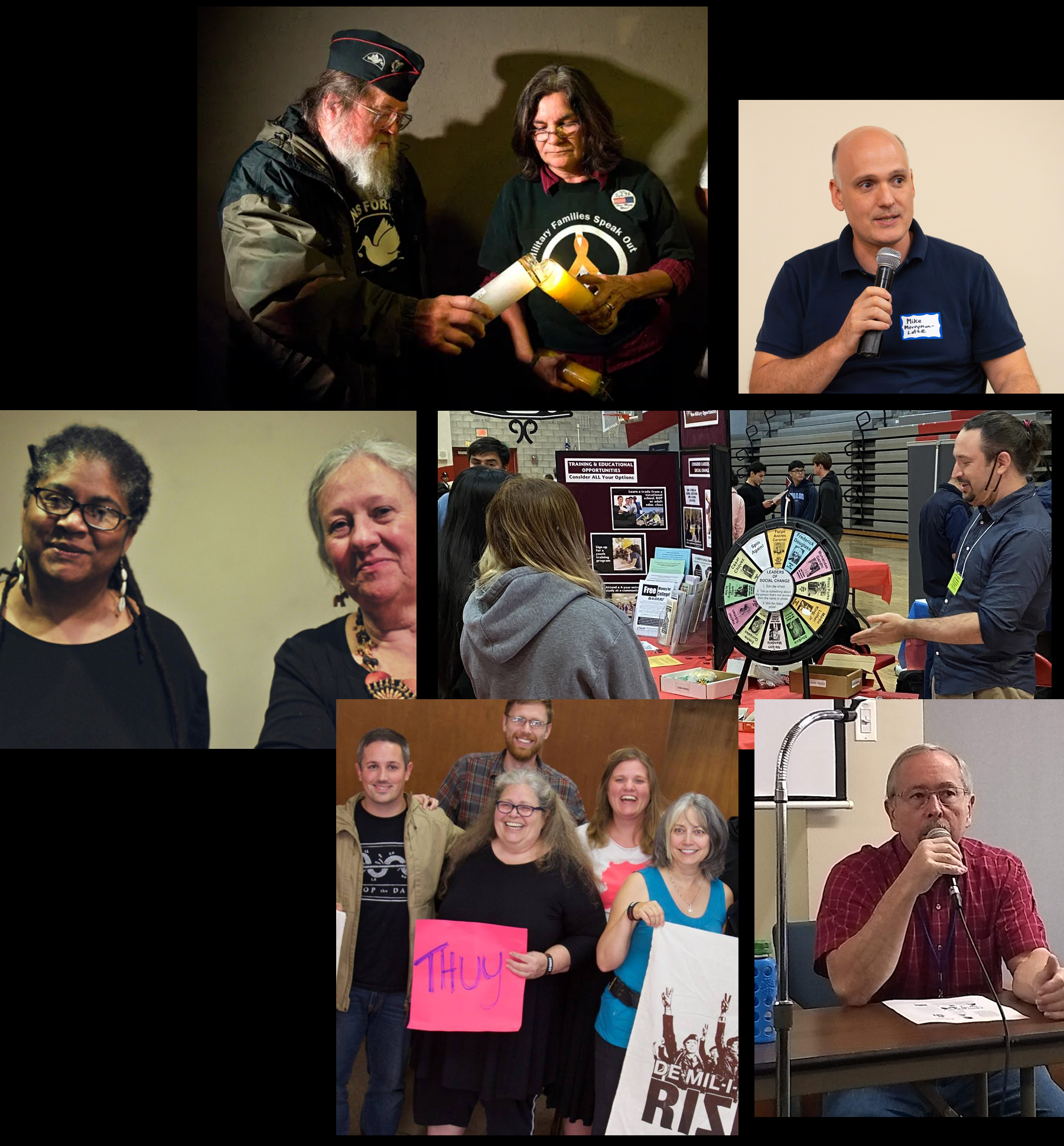
The movement today is smaller and less visible than the one that confronted the Solomon Amendment in the early 2000s. It lacks the dramatic court battles and national headlines that once defined the issue. Nevertheless, it continues through the work of educators, peace organizations, veterans, faith communities, student advocates, and counter-recruitment activists who believe that informed choice requires access to alternatives as well as opportunities.
Counter-recruitment was always Focused on Alternatives to War
The history of opposition to the Solomon Amendment has therefore not come to an end. It has evolved. What began as a legal and constitutional challenge has become part of a broader effort to promote youth rights, educational opportunity, and informed decision-making. The names of the organizations may not appear in newspapers as often as they once did, but the underlying concerns about military recruiting, academic autonomy, and student choice remain very much alive.
For those who continue to say "No" to the Solomon Amendment, the issue has never been solely about military recruiters on campus. It has always been about ensuring that every young person is free to explore all possible futures and make decisions based on knowledge rather than necessity.