
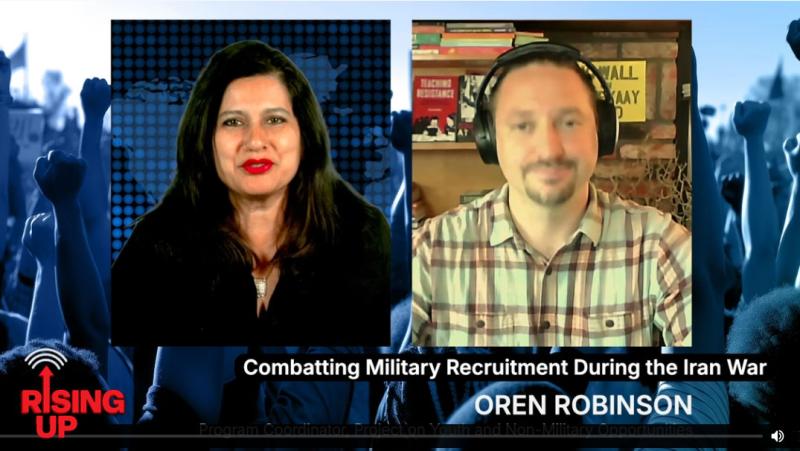
Combatting Military Recruitment During the Iran War | Watch video interview on Vimeo
español -
June 4, 2026 / Sonali Kolhatkar / Rising Up with Sonali - FEATURING OREN ROBINSON - More than a dozen US Armed Forces have died in the course of President Donald Trump’s war on Iran. A man who campaigned against endless wars, has rebranded the Defense Department as the Department of War, and has embroiled the nation in a conflict that seems to have had little cause for provocation, and no end date in sight. What does this mean for young people who, each year are lured to join the military at recruitment events and centers on and near school campuses?
Oren Robinson is Program Coordinator with Project on Youth and Non-Military Opportunities (Project YANO), and as a steering committee member of National Network Opposing the Militarization of Youth (NNOMY). They are also a teaching artist studying militarism, technology, gender and economic justice. Oren spoke with Sonali Kolhatkar about efforts to counter recruitment efforts in light of the Iran war.
ROUGH TRANSCRIPT:
Sonali Kolhatkar: So, let's first get your reflection on the fact that we have a president who campaigned to end wars, because it turns out that wars are sort of uniformly not popular on both sides of the spectrum, and changed the Department of Defense to the Department of War. Does that framing, or did that framing, and the fact that we are in this new war, worry you as somebody who combats military recruitment of young people?
Like What I Do?
Make a donation to show your support for solutions journalism. I am a one-woman operation, doing the work of a team of 4 or 5!
Oren Robinson: Well, again, thanks for having us. We work in public schools and unfortunately, many of our volunteer veterans who come into classrooms with us to speak with students and talk about their real experiences to balance the recruiter's sales pitch will often mention the joke that regardless of the president, we're going to war.
So really, even though the name has changed, the real risk of hyper-militarization of our schools has always been there, and we do see these new threats as a very startling new advent. And that's why there's a lot of action actually that's happening just this past year, that we haven't seen this type of anti-militarism in maybe a generation or more.
GUEST: Oren Robinson is Program Coordinator with Project on Youth and Non-Military Opportunities (Project YANO), and as a steering committee member of National Network Opposing the Militarization of Youth (NNOMY). They are also a teaching artist studying militarism, technology, gender and economic justice.
Kolhatkar: What do you mean by the anti-militarism you're seeing? Are you seeing people who ordinarily are for war showing their opposition?
Robinson: Well, in 2020, at the beginning of the COVID-19 pandemic, there was a steep drop in active military recruits were actually not reaching their targets, their quotas. They had to drop those quotas significantly. And in the meantime, since then, over these past six years and more, we've seen increasing pervasive digital propaganda.
We've seen expanded targeting, even reaching after students who would normally never consider themselves interested in war. And so people are noticing. Students are noticing, teachers are noticing, parents are noticing. Veteran groups, faith groups, groups all over the country are getting together to find different ways to counter this surge of militarization that's in our schools.
Kolhatkar: And recently, the US Armed Forces also raised the enlistment age to 42, which suggests that if they can't lure enough young people, they're going to go after older folks. What do you think?
Robinson: Yeah, well, these threats, including the potential for in last year, December of 2025's NDAA, the Defense Authorization Act, there was a quiet provision slipped in to try to bring back a draft of some kind, an automatic draft registration. So, all of these point to just the increased desperation. But like I was saying at the beginning, these things aren't new.
In fact, even despite having such a culture that celebrates militarism, celebrates might makes right in so many places in US mainstream culture, the military has always faced a recruiting crisis, which is why tax dollars for over a century have always gone to pay for military recruiters to go onto public school campuses.
And they do that through all sorts of ways, including the JROTC, the Junior Reserve Officer Training Corps program, as well as the ASVAB test, which isn't really a test. It's a way that they trick students into giving up their own contact information so that that school where you take the test hands that over to military recruiters who try to recruit you. And that happened to me.
Kolhatkar: Is it too soon to notice whether the launch of the Iran war has made a difference to recruitment numbers among young people specifically?
Robinson: Well, the numbers in polling have suggested that this is one of the least popular wars on record in US history. But it's not just Iran. Just yesterday in the United Nations, they were talking about US support for Israeli attacks in Lebanon. Our current administration has either attacked or threatened to attack over 10 countries, Iran, Iraq, Oman, Yemen, Gaza in Palestine, Syria, Somalia, Nigeria, Colombia, Venezuela, Cuba, Mexico, Canada, and Greenland, at least.
Kolhatkar: So when we think about how military recruiters go after young people, you mentioned the JROTC program. For those who are not as aware, how pervasive is military recruitment on campus, just in general?
Robinson: Yeah. Well, just as the ASVAB calls itself a test, and students think they have to take it, and they don't have to, and the school never cares about what grade you get on that test, in the same way, JROTC has always marketed itself as an actual class that you get on your course schedule when you go back to school in September, usually when you enter in ninth grade.
Many students actually find themselves placed involuntarily, that is, without their prior knowledge or consent, which violates all sorts of laws, including in California state law on top of national laws. And what we see is that this doesn't happen to all schools. Historically, these recruiters, and remember, recruiters are professional salespeople whose job is to meet a quota of new enlistees. Those recruiters go into these schools in poor and working-class and predominantly student of color communities.
Here in San Diego, the wealthiest and most predominantly white schools don't even have JROTC programs, whereas hundreds of students will be placed without having signed a consent form to acknowledge what that class even is when they enter ninth grade each year.
Kolhatkar: And there's also, of course, military recruitment centers that are often placed near college campuses, community college campuses especially, which are predominantly attended by lower income students. It's very clear that they go after people who might feel, realistically and rightfully so, that they don't have too many other economic opportunities, right?
Robinson: Well, this is really the foundation of our work. And, I'm with Project YANO, which is part of a national network, the National Network Opposing the Militarization of Youth, and all over the country, people have been collecting and curating all the different peaceful, non-military career opportunities that exist.
And these exist at national levels, state levels, and local levels. peacefulcareers.org is one source of these lists of lots of job programs, free money for college, vocational training programs that will not track you into military service, unlike this popular conception.
And it's true. Since the end of the formal draft in the Vietnam era, we have experienced the economic draft, the poverty draft. And that increasing inequality goes hand-in-hand with what we've also seen in terms of increased targeting of poor and working-class youth, and also the increase of the school-to-prison pipeline. All these things work to try to pressure students into making that decision, when there's actually many opportunities for other ways to live and make a living.
Kolhatkar: And how does your organization, the national network you mentioned, oppose military recruitment on campuses? What are some of the ways in which you counter it? Because military propaganda can be really effective. It's, of course, very well-funded. We see it often infusing the storylines of Hollywood films. There's a lot of slick ads that paint militarism and war as this noble pursuit that has a lot of honor. How do you counter that? How do you counter that mindset among young people who are obviously impressionable?
Robinson:Yeah. Well, when we go into public schools, which in the Ninth District Court of the United States, that's all of California, West Coast, students actually have the right to hear opposing views about the military because just like you're saying, a lot of the advertising is strictly and primarily to obscure the fact that the military is not just another job.
And that's really what a lot of counter-recruitment is. Anyone can be a counter-recruiter by just learning how to share relevant information with young people who might be facing that choice. And some of those things that the young people should know is that recruiters will lie. They often do lie to meet their quotas.
And that they will, for one thing, not talk about how when you sign that contract, an enlistment contract, that's not just four years of your life, it's up to eight, with the advent of different policies to keep people on past their initial four years. So those are some of the basic facts that a lot of recruiters just won't say. But on top of that, these eight precious years of your life, you could've been spending that time deepening your relationships to the place that you grew up in, to the people who you know, and learning and experiencing the freedom to move and find a fulfilling, sustainable role in society on your own terms and with our communities who are facing so many challenges right now.
And on top of the economic pitch, what people won't often talk about is the social realities of being inside. There's a mental health crisis. There's a sexual assault crisis. Abusers are often protected and even elevated to higher statuses of authority within the military. And so when you're in as an enlistee, oftentimes you're going to be put in some of the most dangerous and disabling situations that anyone could experience.
Kolhatkar: And of course, there's also a lot of homophobia and anti-queer sentiment, which is now institutionalized thanks to the Trump administration, which has barred trans members of the armed forces from serving. So I imagine that that might not be very suitable for young people who are queer or who are allies. It ought to give them pause, right?
Robinson:Well, it's not only the fact that there's these new bans that have been expelling people who depended on that source of income and stability to survive, but remembering that these are actually not good jobs. These are jobs that oftentimes lure you in with false promises that you'll be able to get a college education while you're enlisted, which is near impossible, or that you'll have healthcare.
And a lot of people fight years and years even just to get the very basic healthcare that was promised to them. And so that's one of the things to recognize, too, is that when you are in, you may be forced to do things that are against your morals.
For example we've seen Marines and other active duty deployed to streets of the US to assist in illegal deportations or to protect the deadly ICE raids that are attacking families in our own neighborhoods.
Kolhatkar: And then what are some ways in which people can get involved with the work you're doing? Say that there are parents out who are listening among our audiences or watching, and have noticed aggressive military recruitment on their children's campus. What are the ways in which people can bring some programs to their own children's classrooms? You were mentioning anybody can be a counter-recruiter.
Robinson:Yes, and it's needed now more than ever. As I was sharing earlier, the ways that young people are inundated with recruiters' messages on their phones, at sports games, before movie theater screenings, this is just everywhere. And so everyone can play some role, whether you're involved in a school, a parent, a student, or even just a community member.
In fact, in a few weeks from now, on Saturday, June 13th, we're having a free webinar, a second one this year, on some of these different approaches. We'll be going in depth with workshops on seven different approaches that people have tried out and are continuing to practice for decades, including gaining access to those schools by various means, alternative career path research compilation and sharing those, distributing those at career fairs and other community events. Classroom presentations like what we do with Project YANO, where veterans can visit classrooms of students who are experiencing being exposed to recruiters.
Learning how to organize to actually restrict JROTC. Tabling at career fairs, student clubs, and actions. And really at schools, almost across the board, students are the largest group at any school, and they have the most power if they organize with each other. In fact, just about 10 years ago here in San Diego, students at one school were able to shut down their JROTC program after years of boycotting it.
And in the process, they ended marksmanship trainings across 11 campuses of San Diego Unified School District. This was the Education Not Arms Coalition, which you can learn more about at projectyano.org.
Kolhatkar: I want to just ask you an ideological question briefly. It's wonderful to be able to point people to non-military career alternatives. But unfortunately, the fact is that in this economy where inequality keeps rising, and especially now where AI is sucking up so many jobs and resulting in so many layoffs, there are fewer and fewer options for people. And how do you fold in to the work that you do a critique of a capitalist system that relies on there constantly being an economic underclass, which is, of course, great fodder for military recruiters?
Robinson: Sure. Well, another way of asking this question is why has recruiting been so aggressive over this past century? And it's just like you're saying, because there has been an appetite by lawmakers, by corporations who profit off of war, to keep the capacity and the exercising of that military might. So we know that there's an economic incentive.
And when we go to speak with students, we recognize that really what we can combat in our own day-to-day, within our own school communities and greater learning communities, is that critical inquiry, that critical self-awareness, and recognizing that all of us have had times where we've been forced to follow a rule that we didn't agree with.
And what does it mean to question authority? And what does it mean to question a recruiter's sales pitch? And what does it mean to question why is it that many public schools, the places that poor working-class youth have no choice but to attend a public school, why is it that they have been turned into military induction centers trying to gobble up 40% of students who enroll into a JROTC program go on to enlist?
And so the Department of War has testified to Congress that the JROTC program is their best recruitment tool. So why is it that our entire education system has been shifted to this purpose? But when we go to talk with students, we don't try to make moral arguments. And in fact, what I was just sharing is really my own personal understanding. Because, again, our approach is to bring in a balanced perspective and really put that authority over their own lives back into the hands of students to say, "Actually, this is your choice, and you can make this choice. We're not going to tell you to make this or another choice. We want to make sure that you have the facts so that you can make an informed decision."
Kolhatkar: Give out any resources that you think people should know about if they're interested in counter-recruitment on campuses, and also remind us again of the workshop that you mentioned that folks can attend if they want.
Robinson: Sure, yeah. So even though Project YANO is based in San Diego, we produce literature in English and in Spanish that is referenced and shared nationwide, and all of it is free and available at projectyano.org. Just go to the Resources section, and you can browse by things that are geared towards school staff and counselors and teachers, things geared towards young people and students, things geared towards organizers who are trying to restrict the recruiter access and JROTC access and presence on campus.
So all of those resources, dozens and dozens of pages, and some of those resources are available at projectyano.org. And yes, the webinar that's upcoming, we call it Demilitarization Summer School. It's a workshop series where it'll be small question-answer breakout-style rooms over Zoom. That you can find out more about at nnomy.org/webinar. So NNOMY is the National Network Opposing Militarization of Youth, and that is going to be at 10:00 a.m. Pacific on Saturday, June 13th.
Kolhatkar: I want to thank you so much, Oren, for joining us today, and good luck to you..
Source: https://risingupwithsonali.com/combatting-military-recruitment-during-the-iran-war/
Consider supporting the National Network Opposing the Militarization of Youth
and our work to demilitarize our schools and youth by sending a check to our fiscal sponsor, the AJ Muste Foundation for Peace and Justice, "on our behalf."
Donate here.
###
Updated 11/23/2026 - GDG