
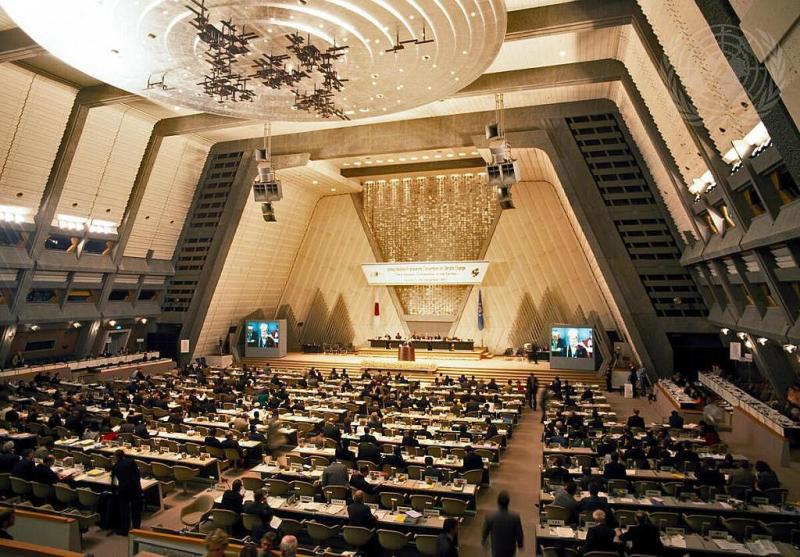
Convening of a COP session at the Kyoto climate change conference in late 1997. (Photo credit: UN image, Frank Leather)
11/26/2026 / nnomyadmin / National Network Opposing the Militarization of Youth – When policymakers at the international level assess the factors driving global climate change and ecological degradation, attention often focuses on commercial aviation, heavy industry, and energy grids designed for consumer use. Yet, one of the world’s largest institutional polluters rarely appears in national emissions registries. Through its vast global network of facilities, its enormous consumption of fossil fuels, and its legacy of toxic waste, the United States military exerts a profound and lasting impact on the planet’s ecosystems.
At the heart of this environmental footprint lies an immense appetite for fossil fuels. The United States Department of Defense is the largest institutional consumer of oil on the planet and, consequently, the largest institutional emitter of greenhouse gases globally. Since 2001, the Pentagon has consistently accounted for between 77 and 80 percent of the total energy consumption of the U.S. federal government. The operation of thousands of combat aircraft, naval vessels, tanks, and supply vehicles—combined with the maintenance of more than 750 overseas bases spread across nearly 80 countries—requires staggering amounts of jet fuel, diesel, and electricity. According to research from Brown University’s "Costs of War" project, between the start of the conflicts following September 11, 2001, and 2018, the U.S. armed forces emitted more than 1.2 billion metric tons of greenhouse gases. If the United States military were a sovereign nation, its annual carbon emissions would exceed those of dozens of industrialized countries. Despite the magnitude of these emissions, the climate impacts of military activity have long remained outside the scope of international scrutiny. During the negotiations for the 1997 Kyoto Protocol, U.S. negotiators secured a blanket exemption that excluded overseas military operations and fuel used by the armed forces (known as "bunker fuel") from national greenhouse gas reporting. Although the 2015 Paris Agreement eliminated this automatic exemption, the reporting of military emissions remains voluntary. Furthermore, direct fuel consumption during operations represents only one part of the carbon equation; indirect emissions—stemming from the vast military-industrial supply chain, the manufacturing of weaponry, and the carbon-intensive reconstruction of infrastructure damaged by war—multiply the true climate cost of military power.
Beyond carbon in the atmosphere, the physical footprint of U.S. military installations leaves deep chemical and ecological scars on the land and water. For decades, routine training exercises, weapons testing, and waste disposal have led to the introduction of hazardous substances into the soil and groundwater. Within U.S. territory, hundreds of military bases—both active and former—have been designated as federal "Superfund" sites due to contamination from heavy metals, unexploded ordnance, solvents, and jet fuel. A particularly widespread threat involves per- and polyfluoroalkyl substances (PFAS)—commonly known as "forever chemicals"—which are used extensively in firefighting foams employed by the military. Hundreds of U.S. military installations have been identified where the leaching of these toxic substances (PFAS) has reached the groundwater, endangering the drinking water supplies of surrounding communities. In 2021, a jet fuel leak at the Red Hill bulk fuel storage facility in Hawaii contaminated the water supply for tens of thousands of residents, highlighting the persistent vulnerability of aging military infrastructure.
Abroad, the environmental consequences of U.S. military operations are often exacerbated by laxer oversight and diplomatic immunity. During the conflicts in Iraq and Afghanistan, the widespread use of open-air "burn pits"—where everything from plastics and electronics to medical and hazardous waste was incinerated—released thick plumes of toxic smoke, affecting both local populations and U.S. military personnel. At various bases in the Pacific and Europe, local governments and environmental groups have frequently raised alarms regarding fuel spills, PFAS leaks, and the discharge of chemical substances. They further point out that Status of Forces Agreements (SOFAs) often limit the ability of host nations to inspect these bases or to compel the Pentagon to fund comprehensive remediation once such facilities are closed. Serious historical legacies also persist: from the use of the defoliant "Agent Orange"—which devastated millions of hectares of forests and farmland in Vietnam and triggered health crises that have affected multiple generations—to nuclear weapons testing in the Marshall Islands, which left entire atolls uninhabitable and contaminated by radioactivity.
It is ironic that the Pentagon itself acknowledges climate change as a key "threat multiplier"—one capable of destabilizing regions, fueling conflicts over resources, and putting coastal military bases at risk due to rising sea levels. In response, the military has invested in localized adaptation measures, such as raising piers, deploying microgrids, and testing alternative fuels. However, various critics and climate researchers point to a fundamental contradiction: incremental improvements in efficiency cannot offset the ecological impact resulting from increased defense budgets, weapons systems—which rely on fossil fuels and are designed to operate for decades—and the global projection of military force. Addressing the environmental impact of the U.S. military ultimately requires more than just "greener" technology; it demands mandatory transparency regarding emissions, rigorous remediation of toxic pollutants—both domestically and abroad—and a deeper reflection on the ecological costs entailed in maintaining a state of permanent military readiness.
References:
- Burr, William, ed. "National Security and Climate Change: Behind the U.S. Pursuit of Military Exemptions to the Kyoto Protocol." National Security Archive, George Washington University, January 20, 2022.
- CNA Corporation. National Security and the Threat of Climate Change. Alexandria, VA: CNA Corporation, 2007.
- Crawford, Neta C. Pentagon Fuel Use, Climate Change, and the Costs of War. Providence, RI: Watson Institute for International and Public Affairs, Brown University, June 12, 2019.
- Crawford, Neta C. The Pentagon, Climate Change, and War: Charting the Rise and Fall of U.S. Military Emissions. Cambridge, MA: MIT Press, 2022.
- Environment & Society Portal. "Aftermaths." Rachel Carson Center for Environment and Society. Accessed November 26, 2026.
- Michaelowa, Axel, and Tobias Koch. "Military Emissions, Armed Conflicts, Border Changes and the Kyoto Protocol." Climatic Change 50, no. 4 (2001): 383–394.
- U.S. Department of Defense. Base Structure Report – Fiscal Year 2023 Baseline. Washington, DC: Office of the Assistant Secretary of Defense for Sustainment, 2023.
- U.S. Environmental Protection Agency. "About the Fuel Releases at the Red Hill Bulk Fuel Storage Facility." Last modified December 2022.
- U.S. Environmental Protection Agency. "EPA and U.S. Army Announce Joint Sampling Project to Identify PFAS Contamination Near Army Installations." News release, July 25, 2024.
- Vine, David, Patterson Deppen, and Leah Bolger. Drawdown: Improving U.S. and Global Security Through Military Base Closures Abroad. Washington, DC: Quincy Institute for Responsible Statecraft, September 20, 2021.
Consider supporting the National Network Opposing the Militarization of Youth
and our work to demilitarize our schools and youth by sending a check to our fiscal sponsor, the AJ Muste Foundation for Peace and Justice, "on our behalf."
Donate here.
###
Updated 11/26/2026 - GDG