Before You Enlist Video - http://beforeyouenlist.org
Researching Pop Culture and Militarism - https://nnomy.org/popcultureandmilitarism/
If you have been Harassed by a Military Recruiter -https://centeronconscience.org/abused-by-recruiters/
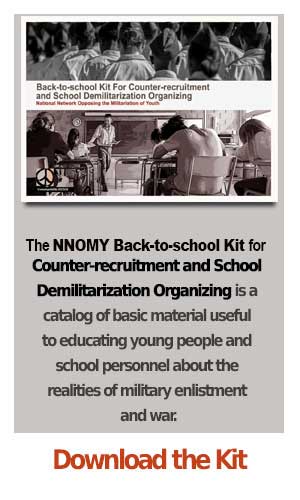
Back-to-School Kit for Counter-recruitment and School Demilitarization Organizing is focused on student privacy
WHAT IS IN THIS KIT? - https://nnomy.org/backtoschoolkit/
Click through to find out
Religion and militarism - https://nnomy.org/religionandmilitarism/
‘A Poison in the System’: Military Sexual Assault - New York Times
Change your Mind?
Talk to a Counselor at the GI Rights Hotline
Ask that your child's information is denied to Military Recruiters
And monitor that this request is honored.
Military Recruiters and Programs Target marginalized communities for recruits...
..and the high schools in those same communities


 Militarization of our Schools

The Pentagon is taking over our poorer public schools. This is the reality for disadvantaged youth.


What we can do

Corporate/conservative alliances threaten Democracy . Progressives have an important role to play.

 Why does NNOMY matter?

Most are blind or indifferent to the problem.
A few strive to protect our democracy.

Articles

The Ukraine War Is Changing U.S. Recruitment—Here’s What Young People Need to Know

espanol - 

February 09, 2026 / NNOMY staff / The National Network Opposing the Militarization of Youth - When the war in Ukraine erupted into global headlines, many young people in the United States saw images of drones buzzing over trenches, soldiers coordinating attacks through phone apps, and cyber teams defending entire cities from digital sabotage. It looked like a different kind of war—high‑tech, fast‑moving, and unpredictable. What’s less visible is how closely the U.S. military has been watching these developments, and how the lessons drawn from Ukraine are now shaping the strategies, budgets, and recruitment messages aimed at American youth.

Featured

A 2026 Counter‑Recruitment Message Inspired by the Portland Legacy

In 2001, Portland activists won a symbolic and practical victory by restricting military access to schools. In 2026, the struggle is more complex—but also more urgent. The tools have changed, the political climate has shifted, and the stakes are higher. But the core mission remains the same.

  espanol -

February 07, 2026 / NNOMY staff / National Network Opposing the Militarization of Youth - In the early 2000s, when Portland Public Schools briefly stood as a national symbol of resistance to military recruitment, the political terrain was almost unrecognizable compared to what counter‑recruiters face in 2026. Back then, the struggle centered on a school board’s authority to keep recruiters out of hallways and cafeterias, and activists found solid footing in the discriminatory logic of “Don’t Ask, Don’t Tell.” The military’s exclusion of LGBTQ+ people gave school districts a clear legal and moral basis to say: if you discriminate, you don’t get access to our students. It was a time when local policy still had teeth, when a determined school board could draw a line and expect it to hold, and when recruiters relied almost entirely on physical presence to reach young people.

Today, that world feels distant. The legal and policy environment has shifted so dramatically that the old strategies seem almost quaint. Federal pressure now saturates the educational system, and compliance with recruiter access is woven into funding streams, audits, and state‑level mandates. The end of DADT removed one of the most straightforward arguments for exclusion, and counter‑recruiters have had to pivot toward concerns that are more complex and diffuse: racialized targeting, immigrant vulnerability, mental‑health risks, and the opaque world of data harvesting. What was once a fight over who could set up a table in a school hallway has become a fight over who controls student information, who shapes their digital environment, and who gets to define their future.

Recruitment tactics have evolved just as dramatically. In 2001, the military’s presence was visible and physical: a uniformed recruiter leaning on a folding table, a glossy brochure, a handshake, a pitch. Violations of the Portland ban were literal trespasses — someone walking into a school they weren’t supposed to enter. The National Guard, exempted from the ban, used that loophole to re‑establish a foothold. But even then, the recruiter’s power depended on charisma, persistence, and face‑to‑face persuasion.

Featured

Techno‑Feudalism and the New Terrain of U.S. Military Recruitment

  espanol -

February 1, 2026 / NNOMY staff / National Network Opposing the Militarization of Youth - Young people today are coming of age inside an economic and social order unlike anything previous generations have known. Their daily lives unfold within a digital landscape dominated by a handful of technology companies that shape how they communicate, work, learn, and even imagine their futures. Scholars increasingly describe this system as techno‑feudalism1 — a world where platform monopolies function less like businesses and more like private fiefdoms, controlling access to opportunity and mediating nearly every aspect of social life. For youth, this is not an abstract theory. It is the environment they navigate from the moment they wake up and check their phones.

In this world, work has become unpredictable and fragmented. Instead of stable jobs with clear pathways, many young people find themselves piecing together income from gig work, part‑time shifts, and temporary contracts that never add up to security. They drive for delivery apps that pay less than minimum wage after expenses, or they work retail jobs where hours fluctuate so wildly that planning for rent or school becomes nearly impossible. The stress of this instability is constant, shaping their sense of what is possible and what is out of reach. It is not a temporary phase but a structural feature of the economy they are inheriting — one that keeps them always available, always hustling, and rarely secure.

This economic precarity creates fertile ground for military recruitment. When civilian life feels unstable and the future uncertain, the military’s promise of steady pay, housing, healthcare, and educational benefits can feel like a lifeline. Recruiters understand this dynamic intimately. They do not need to exaggerate the instability of civilian work; they simply need to reflect it back to young people who are already living it. For many, enlistment appears not just as a job but as the only institution still offering a coherent future. The risks and obligations of military service can feel distant compared to the immediate relief of a predictable paycheck. Precarity narrows the horizon of choice, making enlistment seem less like a decision and more like the only viable path.

Featured

Pentagon warns Scouts to make ‘core value reforms’ or lose military support

  español -

February 03, 2026 / Tara Copp, David Ovall / Washington Post - The Pentagon issued a warning late Monday to Scouting America, formerly known as the Boy Scouts, saying the organization risks losing its long-standing partnership with the U.S. military unless it rapidly implements “core value reforms.”

The public warning, delivered on social media by Pentagon spokesman Sean Parnell, comes just months before thousands of Scouts are expected in West Virginia for National Jamboree, a once-every-four-years camping summit that relies on hundreds of National Guard and active-duty service members for medical, security and logistical support. A sudden loss of that support could jeopardize the youth gathering.

The organization has been in Defense Secretary Pete Hegseth’s crosshairs for years, ever since the group allowed girls to join and in 2024 said it would rebrand as Scouting America to project its inclusiveness. Hegseth is an avowed critic of diversity, equity and inclusion initiatives and has worked aggressively during his tenure atop the Pentagon to purge what he calls “woke” programs — and people — from the institution.

The Pentagon in recent days had begun finalizing plans to end all support for the Scouts, seeking input from the National Guard and the military’s active-duty components on the potential impact of such a move, said multiple people familiar with a draft memo detailing the plans.

If Scouting America does not comply with Hegseth’s demands, which have not been made public, the group could also lose its access to military facilities — which would have a disproportionate impact on military children who participate in Scouting troops at U.S. bases overseas, people familiar with the matter said. Like some others interviewed for this report, they spoke on the condition of anonymity to discuss the Pentagon’s deliberations.

In his post to social media, Parnell said that after a review of the organization, the Pentagon is near a final agreement whereby it would continue supporting the organization because Scouting America has “firmly committed to a return to core principles.”

Featured

Recruiter pitches joining the military to Minneapolis high school students to protect their families from ICE

  español -


Jan 19, 2026 / Haley Britzky / CNN - A military recruiter in Minnesota, pointing to fears over the ongoing ICE operations in Minneapolis, promoted joining the National Guard to high school students highlighting a program that can offer the immediate family of service members some protection against deportation.

The email, sent last week with the subject line “I know [it] is scary out there,” directly addressed ICE detentions.

“All of you have heard about how ICE and how they are taking people without any consideration. … If you are born here and you are 17yrs old, and in a position, like many, where your parents may not be documented. They need you to help!” the email said.

The email pointed to the Parole in Place, or PIP, a program that is run through US Citizenship and Immigration Services. The program is not necessarily guaranteed; it offers parents, spouses, and children of service members protection from deportation on a case-by-case basis, in one-year increments, the USCIS website says. As of fiscal year 2025 it took an average of 4.5 months to process Parole in Place requests.

Tensions have flared in Minneapolis in recent weeks as protestors have faced off with federal law enforcement amid an immigration crackdown by the Trump administration, particularly after the killing of 37-year-old Renee Good earlier this month.

Homeland Security Secretary Kristi Noem said Monday that more than 10,000 “criminal illegal aliens” have been arrested in Minneapolis, though CNN could not independently verify that number.

One source familiar with the recruiting email told CNN it was sent to roughly 200 students at at least one high school in the Minneapolis area. The email immediately caused confusion and concern among the students who received it, the source said.

CNN attempted to contact the recruiter who sent the email, but did not receive a response.

Maj. Andrea Tsuchiya, a Minnesota National Guard spokesperson, acknowledged the email adding that PIP cannot be used until after someone enlists and while the military “may assist with the process … it is driven by the service member and often requires a lawyer.”

Featured

Soft Power Play: A Mother's Reflection on Raising Kids Without “War Practice” at Home

  español -

January 22, 2026 / Emily Graham  -  Moms shape children’s earliest ideas about conflict long before a kid can explain what “war” even is. The toys we buy, the jokes we laugh at, and the stories we put on in the background quietly teach what problems “look like” and how people “solve” them. When play is saturated with enemies, domination, and “win by force,” kids can start treating antagonism as the default script—regardless of gender. The good news: you don’t need a perfect home or a screen-free childhood to steer play toward creativity, mutual care, cooperation, and emotional awareness. Small, repeatable choices—made consistently—add up.

A quick snapshot you can use today is that the aim is to reduce play patterns that normalize violence or enemies as entertainment. The idea is to replace them with play that builds imagination, teamwork, repair, and empathy. When you do that, kids still get excitement and challenge, but their “problem-solving reflex” becomes collaboration instead of conquest.

NNOMY is Funded by

© 2026 NNOMYpeace. Designed By JoomShaper


Gonate time or money to demilitarize our public schools

FAIR USE NOTICE

FAIR USE NOTICE

This site contains copyrighted material the use of which has not always been specifically authorized by the copyright owner. We are making such material available in our efforts to advance understanding of issues connected with militarism and resistance. We believe this constitutes a ‘fair use’ of any such copyrighted material as provided for in section 107 of the US Copyright Law. In accordance with Title 17 U.S.C. Section 107, the material on this site is distributed without profit to those who have expressed a prior interest in receiving the included information for research and educational purposes. For more information go to: https://www.law.cornell.edu/uscode/17/107.shtml. If you wish to use copyrighted material from this site for purposes of your own that go beyond ‘fair use’, you must obtain permission from the copyright owner.

Contact NNOMY

NNOMY

The National Network Opposing

the Militarization of youth
San Diego Peace Campus

3850 Westgate Place
San Diego, California 92105 U.S.A.
admin@nnomy.org  +1 619 798-8335
Tuesdays & Thursdays 12 Noon till 5pm PST
NNOMY Volunteer and Internship Inquiries