Before You Enlist Video - http://beforeyouenlist.org
Researching Pop Culture and Militarism - https://nnomy.org/popcultureandmilitarism/
If you have been Harassed by a Military Recruiter -https://centeronconscience.org/abused-by-recruiters/
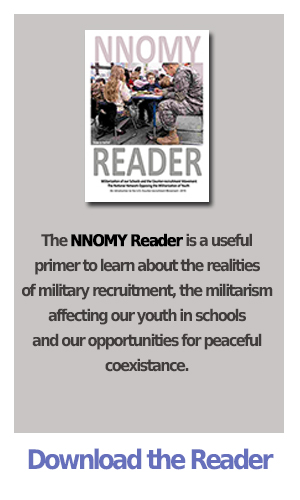
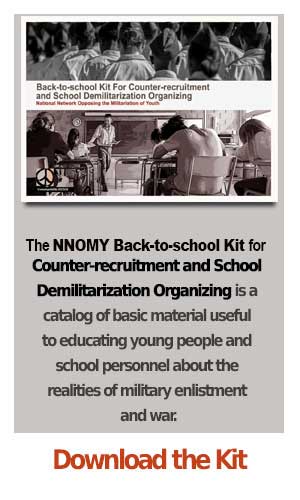
Back-to-School Kit for Counter-recruitment and School Demilitarization Organizing is focused on student privacy
WHAT IS IN THIS KIT? - https://nnomy.org/backtoschoolkit/
Click through to find out
Religion and militarism - https://nnomy.org/religionandmilitarism/
‘A Poison in the System’: Military Sexual Assault - New York Times
Change your Mind?
Talk to a Counselor at the GI Rights Hotline
Ask that your child's information is denied to Military Recruiters
And monitor that this request is honored.
Military Recruiters and Programs Target marginalized communities for recruits...
..and the high schools in those same communities

 Militarization of our Schools

The Pentagon is taking over our poorer public schools. This is the reality for disadvantaged youth.


What we can do

Corporate/conservative alliances threaten Democracy . Progressives have an important role to play.

 Why does NNOMY matter?

Most are blind or indifferent to the problem.
A few strive to protect our democracy.

NNOMY

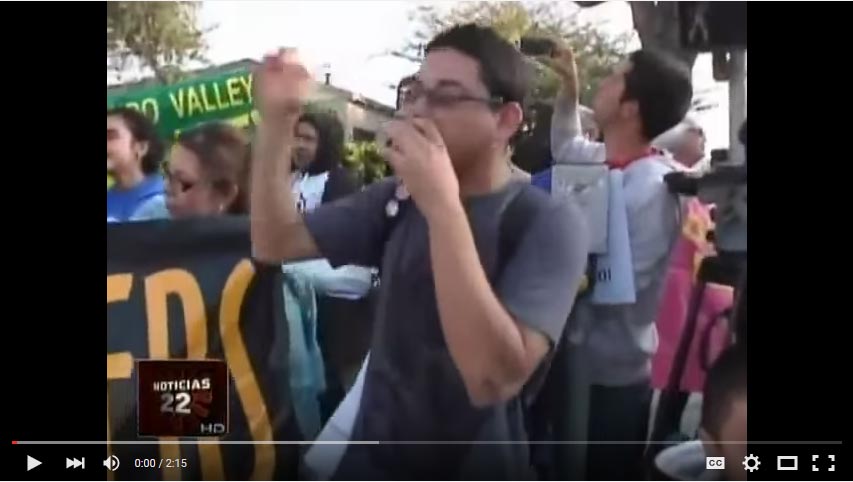
Youth Activists Demand Military-Free Schools

Jorge Mariscal -

On the weekend of July 17, over 250 activists from across the country converged on Roosevelt University in Chicago for the largest meeting ever of counter-recruitment and anti-militarism organizers.  Retirees from Florida and California, concerned parents from Ohio and Massachusetts, veterans from New Mexico and Oregon, grandmothers from Texas and North Carolina joined with youth organizations such as New York’s Ya-Yas (Youth Activists-Youth Allies) and San Diego’s Education Not Arms to consolidate a movement intent on resisting the increased militarization of U.S. public schools.

The building overlooking Lake Michigan vibrated with the positive energy of the diverse participants—people from different generations, regions, and ethnicities mixing together and exchanging stories about their struggle to demilitarize local schools.  For many senior citizens from the East Coast this was the first time they had met much less learned from Chicana high school students who live in border communities near San Diego.  For those relatively new to the counter-recruitment movement, the experience taught them more about the on-going process in which young people are increasingly subjected to military values and aggressive recruiting techniques.

Organized by the National Network Opposing the Militarization of Youth (NNOMY), an alliance of over 180 organizations, the conference included workshops and caucuses on a variety of subjects ranging from the role of class and culture in counter-recruiting, women in the military, and legislative approaches to challenging militarization.

The growth of the counter-recruitment movement benefited greatly from the Bush administration’s slide into totalitarianism.  While established organizations like Project YANO of San Diego and the American Friends Service Committee (AFSC) Youth and Militarism program had been working for decades to demilitarize youth, the passage of the No Child Left Behind Act in 2001 for the first time alerted many to the insidious nature of military recruiting in schools.  Many newcomers to the movement began with “opt-out” campaigns to protect students’ privacy and then moved on to the issue of military aptitude tests (ASVAB) that are often administered covertly in school districts nationwide.

Although some activists during the Bush years saw counter-recruitment solely as an antiwar tactic, the participants at the NNOMY conference understood that militarism is an issue that must be confronted with long-term strategies.  As many of them told me, it is less an issue of stopping current wars (although that is important) than it is of inhibiting the power of the military-corporate-educational complex with the goal of slowly transforming an interventionist and imperial foreign policy.

The symbolism of the conference location was especially important given that the Chicago public school district is the most heavily militarized district in the nation.  The current Secretary of Education Arne Duncan was superintendent of the city’s schools and oversaw the expansion of JROTC and military academies.  Today, Chicago has more academies and more JROTC cadets than any other city in the country.  Under Duncan’s leadership, it will more than likely become a model for the rest of the country.

As Sam Diener reported at the NNOMY conference, the National Defense Authorization Act of 2009 mandates that the military work to increase the number of schools with JROTC from the current total of about 3400 schools to 3700 schools by the year 2020 (a list of schools targeted for new units will be posted shortly on the Peacework Magazine website).

The larger context is alarming.  The decades long defunding of public education, the resultant decline of K-12 systems across the country, and the growth of the charter school movement has produced a situation in which the Pentagon is free to wade into the wreckage with an offer many parents cannot refuse.  In a classic shock doctrine maneuver, the military exerts increasing influence in public schools offering desperate parents programs that will teach their sons and daughters discipline and “leadership skills.”  As Gina Perez explained at the NNOMY meeting, working class youth with limited options, many of whom are active in their community churches, believe they can “make a difference” by joining JROTC.

Despite the Pentagon’s denials, there is no question that militarized school programs operate as covert recruiting programs. Recent studies show that about 40% of all JROTC cadets end up enlisting in the military. Activists working in Georgia recently obtained school district documents that refer to the goal of creating “African American and Hispanic children soldiers.”  What the Pentagon hopes to produce, however, is not cannon fodder as an earlier Vietnam War-era analysis might suggest but rather an educated workforce able to complete the complex tasks of a well-oiled, increasingly high tech, military.

Given the difficulty recruiters have had finding enough high school graduates to fill their quotas, especially in those Latino communities that will provide the largest group of military-age youth for the foreseeable future, it makes sense that the military would attempt to create its own pipeline.  If the public schools cannot turn out enough qualified potential recruits, the Pentagon will do it.  Neoliberalism in the United States may not mean generals in the Oval Office.  But it may mean children in military uniforms marching in formation at a school near you.

The model for this aspect of the militarist agenda is the Chicago public school system where for several years minority neighborhoods have seen the increasing encroachment of the military.  Science teacher Brian Roa, who has written about the Chicago experience, described in a recent truthout article how Mayor Daley and Superintendent Duncan oversaw the expansion of military academies.  “One day the Navy occupied one floor of our school,” Roa said at the NNOMY conference, “and before we knew it they had taken over the second and then the third floor.”

At San Diego’s Mission Bay High School, funding for college preparatory courses was decreased while the principal implemented plans for a Marine Corps JROTC complete with firing range for air rifle practice.  Latino students created the Education Not Arms coalition and successfully convinced a majority on the San Diego Board of Education to ban rifle training at eleven high schools.  Similar success stories were recounted last weekend all of which suggest that not only is militarism a high priority issue for the new century but also that youth activism is alive and well.

The fact that President Obama’s daughters attend Quaker schools while his Secretary of Education oversees the expansion of military programs for working class children is one more glaring contradiction in Obamaland.  The young people who attended the NNOMY conference are aware of the contradiction and left Chicago vowing that they will not passively stand by as their schools become centers for military indoctrination.

More information on the counter-recruitment movement is available at the NNOMY website: http://www.nnomy.org/

JORGE MARISCAL is a Vietnam veteran and a member of Project YANO (San Diego). Visit his blog at: jorgemariscal.blogspot.com/

Still Waiting, Still DREAMing

Jorge Mariscal with Mónica Jaúregui -

For the thousands of young people brought to the United States as children of undocumented immigrant families, a pathway to legalization deferred one more day is a pathway deferred far too long. As we have reported in previous issues of DraftNOtices for almost a decade multiple attempts to pass federal legislation that would legalize these youth have failed. The so-called DREAM Act, or Development, Relief and Education for Alien Minors Act, still lingers in the halls of Congress. But Democratic Party concerns about the 2010 elections, especially in the wake of the health care reform fiasco, may delay further progress on any immigration reform. In the meantime, supporters of the DREAM Act continue to hope. For many, their desperation increases day by day.

The DREAM Act’s most recent incarnation is found in two bills sponsored by Senator Dick Durbin of Illinois and Representative Howard Berman of California. Both Senate bill 729 and H.R. 1751 propose to “permit States to determine State residency for higher education purposes and to authorize the cancellation of removal and adjustment of status of certain alien students who are long-term United States residents and who entered the United States as children, and for other purposes.” Last March, the Senate bill had only 32 co-sponsors and is now stalled at the Committee on the Judiciary; last May, the House bill with 106 co-sponsors was referred to the Subcommittee on Higher Education.

Fighting the Poverty Draft

Jorge Mariscal -

Image by CopilotWhen Boston College student Joe Previtera decided to protest the war in Iraq, he headed to the one place that keeps the war machine well stocked with fuel-his local recruiting office. In a clever display of street theater, Previtera put on a black hood and cape, stood on a cardboard box, and attached stereo wires to his hands. The message was clear enough. The recruiters say money for college but the reality of war says Abu Ghraib.

 No one signed up that day but Previtera was arrested by Boston police and subsequently charged with two felonies having to do with "making false bomb threats" (charges were later dropped). In his act of grass roots pedagogy, Previtera joined a growing number of activists across the country that are focusing their attention on military recruiting as one of the most important fronts in the struggle against militarism and war. While many people continue to generate fearful predictions about an impending draft, others have realized that the so-called volunteer army is already a form of conscription for those young people with limited economic and educational opportunities.

 At the University of Wisconsin in Madison, a group of over fifty people staged an act of civil disobedience outside a recruiting office near campus. Four students and a university employee entered the office and delivered their press release, refusing to leave until the recruiting station was turned into a financial aid office. The four protestors were arrested and charged with trespassing.

Featured

The Poverty Draft

Jorge Mariscal -

Do military recruiters disproportionately target communities of color and the poor?

Recently I stumbled upon an online exchange about why young people join the military. One participant who claimed to be "on the Left" made the following assertion: "Disenfranchisement is the reason why kids join the military and they know going in that it gives them the opportunity to legally and with the blessing of our government kill, torture, and hate other people in order to give an outlet to their hostilities toward society."

Among the many youth I have met over the years as an educator and counter-recruitment activist, I have never met anyone who enlisted so that he or she could "kill, torture, and hate." While "disenfranchisement" may be an accurate word for why some youth enlist, the claim that working-class youth sign up so that they can "legally kill and torture other people" at the very least betrays a profound misunderstanding of why young people join the "all-volunteer military" and at worst reveals biases that separate Americans due to differences of class and race.

On the opposite end of the political spectrum, the conservative claim that most youth enlist due to patriotism and the desire to "serve one's country" is equally misleading. The Pentagon's own surveys show that something vague and abstract called "duty to country" motivates only a portion of enlistees. But the vast majority of young people wind up in the military for different reasons, ranging from economic pressure to the desire to escape a dead-end situation at home to the promise of citizenship.

WHEN MANDATORY MILITARY service ended in 1973, the volunteer military was born. By the early 1980s, the term "poverty draft" had gained currency to connote the belief that the enlisted ranks of the military were made up of young people with limited economic opportunities.

A Call To All Activists to Shut Down the "Army Experience Center"

Pat Elder -

The children of Sparta were drilled in battle using knives and swords. At the Army Experience Center in Philadelphia the same kind of training for warfare is taking place, except children use simulated M-16 automatic rifles and M-240B light machine guns. The training in each scenario is appropriate for different kinds of battle -- facing the dreaded Athenians in hand to hand combat during the Peloponnesian War or launching hellfire missiles to "suspected terrorist targets" in Afghanistan by robotic drones controlled from digital war rooms in suburban Maryland and California.

The Spartans realized the importance of developing the ethos of a warrior caste and we're seeing that same phenomena today in America. This isn't a far-fetched notion. The Pentagon is intent on militarizing American youth at the earliest ages to cultivate this new breed of soldier, based on an ancient model.

Consider the changes made to the U.S. Army's Soldier's Creed. The old creed, discarded in 2003, had soldiers recite, "No matter what the situation I am in, I will never do anything, for pleasure, profit, or personal safety, which will disgrace my uniform, my unit, or my country. I will use every means I have, even beyond the line of duty, to restrain my Army comrades from actions disgraceful to themselves and to the uniform."

Counter-Recruitment Deserves Higher Priority on the Peace Agenda

Pat Elder -

National Guard Bureau Sky's the limit for kids in STARBASE Camp > National Guard > News Features - The National Guard - DOD ImageThe mainstream peace and justice movement is beginning to see that countering military recruitment deserves a higher priority and should be viewed in strategic, rather than tactical terms. Resisting the unprecedented and relentless militarization of American youth transcends the current wars in Iraq and Afghanistan. Countering military recruitment confronts an ugly mix of a distinctively American brand of institutionalized violence, racism, militarism, nationalism, classism, and sexism.  It gets to the root of the problem.

Confronting the work of military recruiters, particularly in the nation’s public schools will provide a catalyst for activists to shift gears from the traditional antiwar tactics of vigils, protests, sit-ins, and CD actions to the long-term strategy of opposing the militarization of youth.  The two are not necessarily mutually exclusive. One however, treats symptoms; the other addresses causes.

Subcategories

The NNOMY Opinion section is a new feature of our articles section. Writing on youth demilitarization issues is quite rare but we have discovered the beginning articles and notes being offered on this subject so we have decided to present them under an opinion category.  The articles presented do not necessarily reflect the views of the NNOMY Steering Committee.


Activists Demilitarizing Our Public Schools

The NNOMY CAMPUS page is a resource for activists wishing to understand how to more effectively intervene in our public schools against the increasing influence of Pentagon programs to indoctrinate our youth for war. A series of webinars are being planned on different successful strategies to effect policy changes in school districts that better protect student privacy from military recruiters, to organize access to counter-recruit on campus, and to monitor the activities of military personnel on public school campuses. Topics are listed by series and subject. NNOMY webinar based workshops are a more effective method to instruct how to proceed with curbing the number of youth that make the choice to join into military service, or do so with a more informed picture of what this service will entail.  This page will be updated periodically as additional webinars are conducted and new materials are produced to support these trainings. NNOMY will maintain these educational resources with the most up-to-date information and informed opinions as possible in order to keep the practice of national counter'recruitment efforts viable into the future.


Available Webinars:    

Michael FlynnThe warning, given to me 25 years ago, came at the moment Pat Robertson and other radio and televangelists began speaking about a new political religion that would direct its efforts at taking control of all institutions, including mainstream denominations and the government. Its stated goal was to use the United States to create a global, Christian empire. It was hard, at the time, to take such fantastic rhetoric seriously, especially given the buffoonish quality of those who expounded it. But Adams warned us against the blindness caused by intellectual snobbery. The Nazis, he said, were not going to return with swastikas and brown shirts. Their ideological inheritors had found a mask for fascism in the pages of the Bible. - Chris Hedges (From his article: The Christian Right and the Rise of American Fascism, 2011)

Revised 04/17/2016

  https://www.nnomy.org/militarizedculture | Versión en español


President Donald J. Trump delivers remarks during the 24th 9/11 Pentagon Observance Ceremony at the Pentagon, Washington, D.C., Sept. 11, 2025. Though the United States of America shares with other nations in a history of modern state militarism, the past 80 years following its consolidation as a world military power after World War II has seen a shift away from previous democratic characterizations of the state.  The last forty five years, with the rise of the neo-conservative Reagan and  Bush (2) administrations, began the abandonment of moral justifications for democracy building replaced by  bellicose proclamations of the need and right to move towards a national project of global security by preemptive military force. Even with the return of eight years of the, so called, Liberal Obama administrations we saw the further erosion of long held human right protections with the suspension of habeas corpus and the increased usage of extra-judicial drone bombing killings of claimed combatants in multiple conflicts worldwide. Again with Biden and now with the Trump administrations, these programs have increased unbeknownst to the general public as the mainstream media silenced and normalized perpetual wars including proxy wars in Israel and Venezuela.

In the process of global military expansion, the US population has been subjected to an internal re-education to accept the role of the U.S. as consolidating its hegemonic rule internationally in the interest of liberal ideals of wealth creation and protectionism.

U.S. Air Force airmen acting as extras during the filming of the 2007 film Transformers at Holloman Air Force Base. A camera operator on an ATV can be seen filming them on the right.The average citizen has slowly come to terms with stealthily increasing campaigns of militarization domestically in media offerings; from television, movies, militarized video games,  and scripted news networks to reinforce the inevitability of a re-configured society as security state. The effect has begun a transformation of how, as citizens, we understand our roles and viability as workers and families in relation to this security state. This new order has brought with it a shrinking public common and an increasing privatization of publicly held infrastructure; libraries, health clinics, schools and the expectation of diminished social benefits for the poor and middle-class. The national borders are being militarized as are our domestic police forces in the name of Homeland Security but largely in the interest of business. The rate and expansion of research and development for security industries and the government agencies that fund them, now represent the major growth sector of the U.S.economy. Additionally, as the U.S. economy continually shifts from productive capital to financial capital as the engine of growth for wealth creation and development, the corporate culture has seen its fortunes rise politically and its power over the public sector grow relatively unchallenged by a confused citizenry who are watching their social security and jobs diminishing.

Special Weapons and Tactics (SWAT) team members, some armed with assault rifles, preparing for an exerciseHow increasing cultural militarization effects our common future will likely manifest in increased public dissatisfaction with political leadership and economic strictures. Social movements within the peace community, like NNOMY, will need to expand their role of addressing the dangers of  militarists predating youth for military recruitment in school to giving more visibility to the additional dangers of the role of an influential militarized media, violent entertainment and play offerings effecting our youth in formation and a general increase and influence of the military complex in all aspects of our lives. We are confronted with a demand for a greater awareness of the inter-relationships of militarism in the entire landscape of domestic U.S. society.  Where once we could ignore the impacts of U.S. military adventurisms abroad, we are now faced with the transformation of our domestic comfort zone with the impacts of militarism in our day to day lives where we are witnessing militarized police forces in all our cities.

How this warning can be imparted in a meaningful way by a movement seeking to continue with the stated goals of counter-recruitment and public policy activism, and not loose itself in the process, will be the test for those activists, past and future, who take up the call to protect our youth from the cultural violence of militarism.

Counter-recruitment poster.The "militarization of US culture" category will be an archive of editorials and articles about the increasing dangers we face as a people from those who are invested in the business of war. This page will serve as a resource for the NNOMY community of activists and the movement they represent moving into the future. The arguments presented in this archive will offer important realizations for those who are receptive to NNOMY's message of protecting our youth, and thus our entire society, of the abuses militarism plays upon our hopes for a sustainable and truly democratic society.

NNOMY


 Please consider becoming a supporter of The National Network Opposing the Militarization of Youth
And our work to demilitarize our schools and youth.
Donate Here


###

Revised / 10/29/2025 - GDG


The Resources section covers the following topics:


NNOMYpeace has organized the following resources for our own staff of activists to promote our campaigns on different social media platforms. Many are formatted for Facebook, Instagram, and Twitter feeds. 

We also welcome those activists inside our network of groups doing Truth in Recruitment and Counter-recruiting activism to utilize there resources for their own social media channels.

If you are not a group associated to NNOMYpeace, and would like to utilize these resources on your own channels, we encourage your groups to integrate to NNOMY on our National Directory of Youth Demilitarization Groups to help support the national community of youth demilitarization groups to know you and the scope of your activism. You can share your information to list your group by submitting an organizational form at the following LINK.

We have distributed the following graphics by campaign. Click on the categories below to see those that support different campaign themes by NNOMY

__________________________________________


The Divest “Your Body” from the War Machine graphics are campaigning resources for social media for the Divest campaign that NNOMY is collaborating with CodePink. NNOMY focuses on asking youth to "Divest of their Bodies" from military service with the war machine. These are strictly to be utilized with counter-recruitment only and not with TIR.

These social media resources are to be utilized with the "Winning the Peace" campaign in cooperation with the palm cards developed by War Resisters League and the support website created for smart phones, "What Everyone Should Know Before Joining the Military / Lo que deberías saber entres de enrolarte en las Fuerzas Armadas (FF.AA.) ,"  to answer questions for youth about what military service really involves for them.

These social media resources focus on groups nationally and regionally that take part in some form of youth demilitarization activism. That can include themes such as Truth in Recruitment or Counter-recruitment activism or participate in outreach to schools as veteral or antiwar speakers. Those using them should be cognizant of the limits that your location and context present before you decide to select the appropriate images and appeals for your use.

The Misc. social media image resources category are designed around various appeals encompassing general counter-recruitment messages and antiwar themes. They should be utilized judiciously with attention paid to the moment and situation of which they are applied. Some of these may be themed along specific important dates in the peace calendar of on specific subject relating to militarization especially those themes that effect youth. Those found in this category are not specific to a campaign.

Back to School Against War & Militarism! Get the 2018-19 Back-to-school Kit for Counter-recruiting and School De-militarization Organizing from The National Network Opposing the Militarization of Youth and find out how you can help keep our youth safer and send a message to school officials and your government... military recruiters should be monitored in local high school and minor-aged youth deserve a balanced narrative on military service! Act Now to activate in your child's public school against Pentagon intrusions into our community youth.

The "Eliminate Selective Service for Everyone" campaign category addresses the antiquated Selective Service system and the demand for its elimination. With the issue of women now being qualified for combat duties including fighting, the issue has been brought before the congress and senate of the United States to require women to register, like men, in the years when young adults are typically drafted into the services to fight wars if the draft needs to be re-initiated in the event of a national crisis where there are not sufficient troops to meet the troop requirement.

This campaign, "Eliminate Selective Service for Everyone," asks for the elimination of this demand based on it being a violation of basic and internationally recognized human rights protocols including the Universal Declaration of Human Rights.

https://nnomy.org/selectiveservice

The "Costs of War" campaign category came from the Watson Institute for International Affairs website of Brown University in Providence, RI. This institute has made their research into the economic, social, political, and human costs of U.S. wars their research focus. Their mission statement explains the following:

The Costs of War Project is a team of 50 scholars, legal experts, human rights practitioners, and physicians, which began its work in 2010. We use research and a public website to facilitate debate about the costs of the post-9/11 wars in Iraq and Afghanistan, and the related violence in Pakistan and Syria. There are many hidden or unacknowledged costs of the United States’ decision to respond to the 9/11 attacks with military force. We aim to foster democratic discussion of these wars by providing the fullest possible account of their human, economic, and political costs, and to foster better informed public policies.

This campaign, "Costs of War," asks for the public to be aware that our post 9/11 foreign policy has an effect on the U.S.'s international relations that are increasingly coming under question domestically and internationally and how those policies align with the stated goals of the U.S. State Department and its allied governments..

https://nnomy.org/costsofwar

NNOMY Peace produces workshops to assist groups in understanding the tactics of military recruiters in the school and the community and create community and strategies for groups envolved in youth demilitarization efforts.

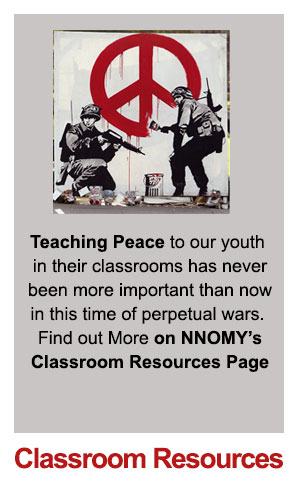
NNOMYpeace produces printable and viewable resources to support the practice of Truth in Recruitment and Counter-recruitment activism.

News reports from the groups associated to the NNOMY Network including Social Media.

Reports from counter-recruitment groups and activists from the field. Includes information about action reports at recruiting centers and career fairs, school tabling, and actions in relation to school boards and state legislatures.

David SwansonDavid Swanson is the author of the new book, Daybreak: Undoing the Imperial Presidency and Forming a More Perfect Union, by Seven Stories Press and of the introduction to The 35 Articles of Impeachment and the Case for Prosecuting George W. Bush by Dennis Kucinich. In addition to cofounding AfterDowningStreet.org, he is the Washington director of Democrats.com and sits on the boards of a number of progressive organizations in Washington, DC.


Charlottesville Right Now: 11-10-11 David Swanson
David Swanson joins Coy to discuss Occupy Charlottesville, protesting Dick Cheney's visit to the University of Virginia, and his new book. -  Listen

Jorge MariscalJorge Mariscal is the grandson of Mexican immigrants and the son of a U.S. Marine who fought in World War II. He served in the U.S. Army in Vietnam and currently teaches at the University of California, San Diego.

Matt GuynnMatt Guynn plays the dual role of program director and coordinator for congregational organizing for On Earth Peace, building peace and nonviolence leadership within the 1000+ congregations of the Church of the Brethren across the United States and Puerto Rico. He previously served a co-coordinator of training for Christian Peacemaker Teams, serving as an unarmed accompanier with political refugees in Chiapas, Mexico, and offering or supporting trainings in the US and Mexico.

Rick Jahnkow

Rick Jahnkow has worked for two San Diego-based anti-militarist organizations, the Project on Youth and Non-Military Opportunities and the Committee Opposed to Militarism and the Draft. Rick Jahnkow, one of both organization’s founders, first became active organizing draft resistance and opposition to the Vietnam War. He can be reached at: This email address is being protected from spambots. You need JavaScript enabled to view it.

Counter-recruitment and school demilitarization work in the U.S. has gone through several cycles of expansion and contraction during the last few decades. The first expansion was during the early 1980s when it was supported by a small number of national organizations, such as the American Friends Service Committee (AFSC), War Resisters League, Central Committee for Conscientious Objectors (CCCO) and National Lawyers Guild. Most grassroots activities at the time were carried out by chapters of these organizations and a number of independent community peace groups (including COMD and, eventually, Project YANO).

Many counter-recruitment organizers in the 1980s came from the Vietnam-era anti-draft movement, so it was common for them to include draft counseling information as they also worked to counter the presence of military recruiters in schools. This dual emphasis was encouraged by the return of Selective Service registration in 1980 and the government’s various efforts to coerce young men into compliance. Frequently, organizers saw no distinction between the issues of recruiting and Selective Service registration, which had both positive and negative consequences. It was positive in the sense that fear of a possible return to the draft fueled more youth-focused organizing and helped increase awareness of recruiting and militarism in schools. But on the negative side, the frequent focus on Selective Service kept many activists from fully comprehending that economics had become the primary factor driving the militarization of young people, and that draft counseling was not an effective approach to the problem. Another negative consequence was that as concern about conscription diminished in the late 1980s, the overall level of counter-recruitment work also fell considerably.

Fortunately, those groups that did continue to organize deepened their analysis and developed more appropriate and effective organizing approaches. For example, they focused on addressing the “poverty draft” by compiling and distributing literature on alternatives to enlistment. At the same time, they sought to either eliminate recruiters from schools or at least secure equal access to give students alternative information. As the tactics evolved and improved, there were a number of important achievements. For example:


The principle of equal school access for counter-recruiters was realized in many places, thanks to a combination of effective organizing and a few successful lawsuits decided in the late 1980s. The broadest legal precedent for equal access came in a 1986 ruling won by COMD in the federal Ninth Circuit Court of Appeals.


  • Solid research produced high-quality tools for grassroots organizing, including a professionally produced slide show that eventually evolved into a powerful educational DVD, “Before You Enlist,” which is used widely today.
  • In many places, school policies were passed that severely curtailed, or completely banned, recruiter access to students.
  • Opportunities for successful cross-community and cross-issue organizing developed that had not been available to the traditional U.S. antiwar movement.

Read More


Media:

Publications:

Group affiliations:

Special Collections & University Archives:

  • Committee Opposed to Militarism and the Draft Records
    1979-2021 Bulk: 1980-1987
    http://scua.library.umass.edu › category › social-change › draft-resistan…
    Draft resistance – Special Collections & University Archives
    Formed in 1979 in the wake of a congressional vote on reinstating the draft, the Committee Opposed to Militarism and the Draft (COMD) was formed by San Diego-based anti-war activists Bill Roe, Hoppy Chandler, Norm Lewis, Fritz Sands, and Rick Jahnkow.

    ###


Pat ElderPat Elder was a co-founder of the DC Antiwar Network (DAWN) and a member of the Steering Committee of the National Network Opposing the Militarization of Youth, (NNOMY).  Pat is currently involved in a national campaign with the Women's International League for Peace & Freedom project, Military Poisons,  investigating on U.S. military base contamination domestically and internationally.  Pat’s work has prominently appeared in NSA documents tracking domestic peace groups.


Documents:

audio  Pat Elder - National Network Opposing the Militarization of Youth

NNOMY periodically participates in or organizes events(e.i. conferences, rallies) with other organizations.

News articles reposted about NNOMY. Includes news reports about our work with associated groups and conferences.

The Counter-recruitment Essentials section of the NNOMY web site covers the issues and actions spanning this type of activism. Bridging the difficult chasms between religious, veteran, educator, student, and community based activism is no small task. In this section you will find information on how to engage in CR activism in your school and community with the support of the knowledge of others who have been working to inform youth considering enlisting in the military. You will also find resources for those already in the military that are looking for some guidance on how to actively resist injustices  as a soldier or how to choose a path as a conscientious objector.

John Judge was a co-founder of the Committee for High School Options and Information on Careers, Education and Self-Improvement (CHOICES) in Washington DC, an organization engaged since 1985 in countering military recruitment in DC area high schools and educating young people about their options with regard to the military. Beginning with the war in Viet Nam, Judge was a life-long anti-war activist and tireless supporter of active-duty soldiers and veterans.


"It is our view that military enlistment puts youth, especially African American youth, at special risk, not only for combat duty, injury and fatality, but for military discipline and less than honorable discharge, which can ruin their chances for employment once they get out. There are other options available to them."


In the 1970's the Selective Service System and the paper draft became unworkable, requiring four induction orders to get one report. Boards  were under siege by anti-war and anti-draft forces, resistance of many kinds was rampant. The lottery system failed to dampen the dissent, since people who knew they were going to be drafted ahead of time became all the more active. Local draft board members quit in such numbers that even I was approached, as a knowledgeable draft counselor to join the board. I refused on the grounds that I could never vote anyone 1-A or eligible to go since I opposed conscription and the war.

At this point the Pentagon decided to replace the paper draft with a poverty draft, based on economic incentive and coercion. It has been working since then to draw in between 200-400,000 enlisted members annually. Soon after, they began to recruit larger numbers of women to "do the jobs men don't want to". Currently recruitment quotas are falling short, especially in Black communities, and reluctant parents are seen as part of the problem. The hidden problem is retention, since the military would have quadrupled by this time at that rate of enlistment, but the percentage who never finish their first time of enlistment drop out at a staggering rate.

I began bringing veterans of the Vietnam War into high schools in Dayton, Ohio in the late 1960s, and have continued since then to expose young people to the realities of military life, the recruiters' false claims and the risks in combat or out. I did it first through Vietnam Veterans Against the War/Winter Soldier Organization, then Dayton Draft & Military Counseling, and since 1985 in DC through C.H.O.I.C.E.S.

The key is to address the broader issues of militarization of the schools and privacy rights for students in community forums and at meetings of the school board and city council. Good counter-recruitment also provides alternatives in the civilian sector to help the poor and people of color, who are the first targets of the poverty draft, to find ways to break into the job market, go to a trade school, join an apprenticeship program, get job skills and placement help, and find money for college without enlisting in the military.

John Judge -- counselor, C.H.O.I.C.E.S.
 
Articles
References:
Videos
Tributes

###


https://nnomy.org/popcultureandmilitarism/

Selene Rivas presents for the International Week of Action Against the Militarisation of Youth a series of brief articles exploring how the U.S. citizenry has been normalized to accept a permanent state of militarism through popular culture: Movies, video games and comic books. From Monday, November 20th and continuing through Sunday the 26th of November, 2017, a new segment of this series of short articles will be featured each day. Select from the articles below.

You can find out more about the Week Of Action at War Resisters' International.

 https://nnomy.org/edwardhasbrouck

Edward Hasbrouck grew up in Wellesley, Massachusetts, a suburb of Boston. He considers myself primarily a political activist. Hasbrouck began his resistance to the violence of illegitimate authority as an elected but nonvoting student representative to the local school board and as an activist for peace, disarmament, and students' rights. His first book was a handbook for high school students on their legal rights co-authored in the summer of 1977, between high school and college, as an intern for the student service bureau of the Massachusetts Department of Education. He majored in political science at the University of Chicago until leaving school to pursue direct involvement in political activism.


Conscription of young people to fight old people's wars is one of the ultimate expressions of ageism, and for me, resistance to an ageist draft was first and foremost a component and continuation of the struggle for youth liberation. The religious and authoritarian justifications for conscription and war are remarkably similar to the religious and authoritarian rationales for violence against children and for slavery. - Edward Hasbrouck


In 1980, after a five-year hiatus, the U.S. government reinstated the requirement that all young men register for military conscription with the Selective Service System. In 1982, Hasbrouck was selected for criminal prosecution by the U.S. Department of "Justice" (specifically, by William Weld and Robert Mueller) as one of the people they considered the most vocal of the several million nonregistrants for the draft. As one of 20 nonregistrants who were prosecuted before the government abandoned the enforcement of draft registration, Hasbrouck was convicted and "served" four and a half months in a Federal Prison Camp in 1983-1984. The high-profile trials of resistance organizers proved counterproductive for the government. These trials served only to call attention to the government's inability to prosecute more than a token number of nonregistrants, and reassured nonregistrants that they were not alone in their resistance and were in no danger of prosecution unless they called attention to themselves.


Articles:

Resources:


###


NNOMY is Funded by

© 2025 Your Company. Designed By JoomShaper


Gonate time or money to demilitarize our public schools

FAIR USE NOTICE

FAIR USE NOTICE

This site contains copyrighted material the use of which has not always been specifically authorized by the copyright owner. We are making such material available in our efforts to advance understanding of issues connected with militarism and resistance. We believe this constitutes a ‘fair use’ of any such copyrighted material as provided for in section 107 of the US Copyright Law. In accordance with Title 17 U.S.C. Section 107, the material on this site is distributed without profit to those who have expressed a prior interest in receiving the included information for research and educational purposes. For more information go to: https://www.law.cornell.edu/uscode/17/107.shtml. If you wish to use copyrighted material from this site for purposes of your own that go beyond ‘fair use’, you must obtain permission from the copyright owner.

Contact NNOMY

NNOMY

The National Network Opposing

the Militarization of youth
San Diego Peace Campus

3850 Westgate Place
San Diego, California 92105 U.S.A.
admin@nnomy.org  +1 619 798-8335
Tuesdays & Thursdays 12 Noon till 5pm PST
NNOMY Volunteer and Internship Inquiries