Before You Enlist Video - http://beforeyouenlist.org
Researching Pop Culture and Militarism - https://nnomy.org/popcultureandmilitarism/
If you have been Harassed by a Military Recruiter -https://centeronconscience.org/abused-by-recruiters/
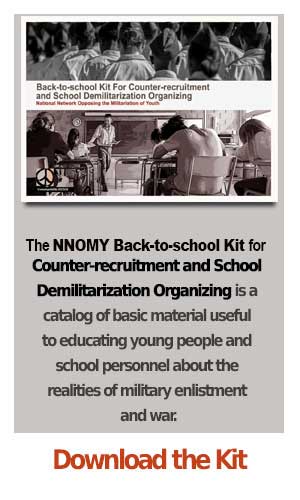
Back-to-School Kit for Counter-recruitment and School Demilitarization Organizing is focused on student privacy
WHAT IS IN THIS KIT? - https://nnomy.org/backtoschoolkit/
Click through to find out
Religion and militarism - https://nnomy.org/religionandmilitarism/
‘A Poison in the System’: Military Sexual Assault - New York Times
Change your Mind?
Talk to a Counselor at the GI Rights Hotline
Ask that your child's information is denied to Military Recruiters
And monitor that this request is honored.
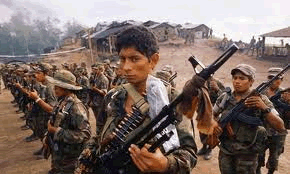
Military Recruiters and Programs Target marginalized communities for recruits...
..and the high schools in those same communities

 Militarization of our Schools

The Pentagon is taking over our poorer public schools. This is the reality for disadvantaged youth.


What we can do

Corporate/conservative alliances threaten Democracy . Progressives have an important role to play.

 Why does NNOMY matter?

Most are blind or indifferent to the problem.
A few strive to protect our democracy.

NNOMY

A Strategic Blind Spot for Progressives

Rick Jahnkow -

Many advocates of progressive social change in this country are asking important questions about possible directions to follow after the 2008 election. For the peace movement, this question is particularly challenging because, while there is good reason to celebrate the defeat of the Republican Party and the election of the first African American president, there is also a real danger that Obama’s victory will undercut anti-war protest if he doesn’t move quickly to end the Bush administration’s two wars.

Many liberals might feel overly confident about the degree of change that is coming and decide that the new administration deserves to be given breathing space. It would then become much harder to mobilize opposition if Obama made good on his promise to shift the emphasis on military action from Iraq to Afghanistan.

Surprise Attempt to Force Military Training into High Schools Fails — for Now

Rick Jahnkow -

On September 17, 2008, the U.S. Senate was presented with an amendment to the 2009 military authorization bill that would have forced high schools to accept military training. The amendment would have accomplished this by denying all federal funds to any school district that did not allow the various military branches to establish, maintain or operate a unit of the Junior Reserve Officer Training Corps (JROTC). Each military branch has its own JROTC program.

The amendment was introduced by Senator John Cornyn, a Texas Republican, and was buried among over 250 other amendments proposed for the 2009 military authorization bill. The method of attaching such amendments to major pieces of legislation is the way Congress passed laws in the 1990s that require colleges and universities to grant access to military recruiters and permit the establishment of college ROTC units. Those laws, which were later upheld by the Supreme Court, paved the way for an amendment to the No Child Left Behind Act of 2001 that is now forcing school districts to give recruiters access to secondary school students.

2005 Could Be a Turning Point for the Antiwar Movement

Rick Jahnkow -

Despite 2005 being the start of a second presidential term for George W. Bush, this year may bring together a number of factors that will offer the antiwar movement an important opportunity to shorten the U.S. occupation of Iraq and begin to reverse the decades-long growth of militarism in this country. However, to take advantage of this opportunity, the antiwar movement will have to think critically about its emphasis on symbolic war protest and look more closely at strategies for interfering with the flow of human resources needed for war, especially through counter-recruitment organizing.

As the year began, it should have been clear to everyone that the neocon plan for the Middle East pursued by the Bush administration had run into a brick wall. The invasion and occupation of Iraq is now the quagmire that many predicted, and U.S. actions in the region have created less political stability instead of more. Meanwhile, total annual spending on war and the military has reached almost half a trillion dollars, which is being financed by running up major deficits and proposing budget cuts in domestic programs that will generate much anger in the coming months toward Bush and his Republican majority. The increasing reports of Republican realists publicly criticizing Bush policies — especially over Iraq — indicate that beneath the surface, opinion against the neocons is growing even within the conservative base of Bush's own party.

Perhaps most importantly, a developing crisis in the military force structure caused by Bush's wars in Afghanistan and Iraq will soon push the Pentagon into a position where
it can no longer carry out the mission that has so far been handed to it. Reserve and National Guard forces now make up 40% of the troops in Iraq, but the National Guard missed its recruitment quota by 13% last year and Reserve forces are "rapidly degenerating into a 'broken' force," according to a December 2004 memo by the chief of Army Reserves, Lt. Gen. James R. Helmly. Earlier in the year, a report by the Defense Science Board, a Department of Defense advisory group, concluded that the U.S. military could not maintain its current peacekeeping commitments in Iraq and Afghanistan without a significant increase in the size of the armed forces or scaling back the objectives of its missions. The Bush administration has publicly stated it intends to "stay the course," but trying to resolve this problem by increasing the size of the military is appearing to be impossible without a draft, and that route, if chosen, would be an absolute disaster for the Pentagon.

Thirty years ago, the public image and influence of the military establishment had reached a low point because of controversy over the Vietnam War and the draft that was used to fight it. When massive war resistance and the general social upheaval of the time forced an end to the draft, the Pentagon had to begin relying on aggressive marketing to fill the armed forces' ranks and improve its relationship with the public. As a result of this forced shift in strategy, the military has been gradually expanding its presence in K-12 schools and strengthening its ability to propagandize through other institutions of socialization. Those efforts, together with a less risky war fighting doctrine that grew out of the so-called Vietnam Syndrome, have helped the military establishment rehabilitate its image and expand its influence to an unprecedented level.

Right now, however, public opposition to the war in Iraq is increasing and antagonism toward the draft is still running extremely high — so high that the Republicans in Congress felt it necessary to bring Congressman Rangel's nonviable draft bill to the floor just so it could be voted down 402-2, and both Bush and Kerry felt compelled to publicly promise there would be no draft if they were elected. Furthermore, the Pentagon knows that all of its political gains over the last 30 years would be jeopardized by the firestorm of hostility that would be triggered if, once again, conscription were used to force people to fight an unpopular, risky war. It would mean that recruiters and ROTC programs would come under fierce attack on college campuses, as would the military recruiters and military-linked programs that have invaded our K-12 schools, including Jr. ROTC, military aptitude (ASVAB) testing, the Young Marines and the many military/school partnerships that have been taking root at all school levels.

If the military believes it can't marshal the resources needed to carry out its mission, and if the draft is an unacceptable solution because of the perceived likelihood of a severe political backlash, it leaves only the choice of changing the mission — which essentially means the U.S. would have to find a way to begin phasing out its occupation of Iraq relatively soon. And even though Bush has talked about staying the course, there is little else he can do if the troops, money and will are not there to continue, and if the career officers at the Pentagon become more publicly vocal in defending their own vital institutional interests — which in this case are served by changing the mission rather than resorting to a draft.

The key to actualizing this result is maintaining the perception that neither a draft nor aggressive recruiting can enable the mission to continue. The antiwar movement has an opportunity to do this by shifting its strategy to make counter-recruitment organizing and the demilitarization of schools a higher priority.

Doing this can accomplish several goals:

1. By supporting and facilitating more organizing against the military's presence in schools, we can communicate clearly that even more dire consequences are around the corner if there ever is a draft.

2. It encourages more youth activism and addresses the dangerous trend toward greater militarization of education, which if not reversed will lay the foundation for future wars and make a draft much more likely.

3. More than just offering protest, it provides a way to materially interfere with the government's ability to sustain the occupation of Iraq and pursue other preemptive wars, and in the process, we can push the Pentagon toward expressing more direct public criticism of the administration's handling of the war and of the Bush Doctrine in general.

One of the barriers to counter-recruitment activism in colleges and universities has been a set of laws, known as the Solomon Amendments, which since 1997 has threatened campuses with the loss of federal funds if they ban recruiters and ROTC. A parallel law was implemented in 2002 to stop high schools from restricting recruiter access to students and student lists. Multiple lawsuits challenging the college-related law were introduced in 2003, and on November 29, 2004, the U.S. Court of Appeals for the Third Circuit ruled that the Solomon Amendments violated the plaintiffs' free speech. While there is a good chance the federal government will appeal the ruling to the U.S. Supreme Court, there is currently an important window of opportunity to escalate college counter-recruitment organizing to a level of intensity that hasn't existed in recent years. There is also a possibility for some high school districts that formerly had restrictions on recruiter access to reinvoke them, which in the current climate of concern about predatory recruiters and the Iraq war could inspire a larger number of districts to adopt such restrictions.

Even if the court ruling against mandatory recruiter access to colleges is eventually overturned by the Supreme Court, there are still many possibilities for challenging and resisting the military's efforts to recruit and indoctrinate young people, as has been demonstrated by the grassroots groups belonging to the National Network Opposing the Militarization of Youth (www.youthandthemilitary.org). And there is also new inspiration to be drawn from the creative direct action protests that have been recently occurring at recruiting stations, including the takeover of one recruiting center in Madison, Wisconsin, by individuals demanding that it be turned into a college financial aid office.

Organizing such activities is a way for people to actually nonviolently stand in the way of what's being done in Iraq and have a tangible effect. More antiwar activists are gradually realizing how much this is needed and that symbolic protest, though valuable, is not enough. Hopefully, a larger portion of the antiwar movement will also realize it, and 2005 will become the turning point that is badly needed.

Sources: New York Times, September 20, 2003; Baltimore Sun, January 5, 2005.

This article is from Draft NOtices, the newsletter of the Committee Opposed to Militarism and the Draft (http://www.comdsd.org)


In Need of a Proactive Peace Movement

Rick Jahnkow -


Some important stories have appeared recently about disagreements between military commanders and the Bush administration over whether to begin a significant withdrawal of U.S. forces from Iraq in 2006. A related development is the recent call for an immediate withdrawal by Rep. John Murtha (D-PA). Murtha is a decorated combat veteran who is also considered a military hawk and one of the closest congressional allies of the high-level officer corps.

Peace organizations have been quick to add Murtha’s name to the growing list of those calling for an end to the U.S. occupation of Iraq, but they’ve given scant attention to the true significance of his voice and the very potent implications of stories about military commanders’ dissatisfaction with their mission.

A more in-depth analysis of these developments and related issues can offer some important lessons on how the peace movement can hasten the end of the occupation and move proactively beyond the limited goal of ending one war.

Military Generals and the Peace Movement

For a couple of years now, some of us have been arguing that the turning point for the peace movement will come when it recognizes that counter-recruitment organizing is the most practical way to tangibly affect current U.S. foreign policy.

The argument is based on simple but compelling logic: The Bush administration and conservative-dominated Congress can continue to ignore anti-war demonstrations and other symbolic forms of protest, but they cannot ignore the fact that without enough soldiers, it is impossible to sustain a large, long-term occupation in a country like Iraq.

An additional assumption is that if the recruitment climate becomes sufficiently hostile, the military leadership will foresee serious, long-term damage to both the functionality and influence of their institution and will act to protect its interests. The combined criticism of military leaders and their allies in Congress could then produce a crisis that would force an accelerated withdrawal from Iraq and also diminish the likelihood of other U.S. invasions in the region. In essence, an “Iraq syndrome” would replace the deceased “Vietnam syndrome.”

In recent months, some elements of this equation have begun to come together. After an ominous shortfall in first-time enlistments last fiscal year, re-enlistment rates are now falling below quota, and some parts of the armed forces, especially the Army, continue to fall behind in overall recruiting. The prospects for turning this trend around look extremely poor for 2006, and according to reported comments by military insiders, the Pentagon is beginning to panic. This is apparently forcing the Bush administration to budge on its “stay the course” approach and begin talking about troop reductions in the near future.

Journalists Paul Richter and Tyler Marshall wrote the following in a Los Angeles Times article titled “U.S. Starts Laying Groundwork for Significant Troop Pullout From Iraq”:

Some analysts believe the potential long-term damage to the armed forces, not political pressure, could be the decisive factor for Bush and his advisors.

Andrew Krepinevich, a former Pentagon official who heads the Center for Strategic and Budgetary Assessments, an independent defense research group in Washington, argues that these strains have become a key factor informing administration thinking.

Unlike the Vietnam era, when the military had a nearly endless supply of draftees, the Iraq experience has sharply reduced the flow of recruits into the volunteer armed forces and attrition rates are alarmingly high, Krepinevich noted.

Other factors, such as federal restrictions on the frequency of National Guard deployments, also limit available personnel.

This summer, differences between the White House and some military commanders over troop reductions were the result of these problems, analysts believe. Although divisions remain within the administration, there are increasing signs that Bush may be calculating that a faster drawdown carries fewer long-term risks.

“I think the administration will yield to the reality of an Army that is apparently beginning to buckle under the strain of these long-term deployments,” Krepinevich said.

The problem for military leaders wishing to express themselves publicly about this issue is that as long as they are still commissioned officers, they are discouraged by military convention and law from doing anything that could be seen as undermining the authority of their commander-in-chief, George W. Bush. If they wish to avoid legal and professional risks for speaking out, they have to find indirect ways to communicate their criticisms. This, in fact, is what some Pentagon insiders say was being done through Rep. Murtha. As noted by Alexander Cockburn in a piece posted at CounterPunch.org, “The immense significance of Rep. John Murtha's November 17 speech calling for immediate withdrawal from Iraq is that it signals mutiny in the U.S. senior officer corps.” (See “The Revolt of the Generals,” Counter Punch, Dec. 3, 2005.)

Included in Murtha’s speech was the following statement, undoubtedly based on briefings he received from his Pentagon confidants:

The future of our military is at risk. Our military and our families are stretched thin. Many say the Army is broken. Some of our troops are on a third deployment. Recruitment is down even as the military has lowered its standards. They expect to take 20 percent category 4, which is the lowest [intelligence] category, which they said they'd never take. They have been forced to do that to try to meet a reduced quota.

One thing the Army has done to temporarily try to keep the recruiting crisis from snowballing is lower its recruiting quotas for the early part of fiscal year 2006 (33% less than the same period in 2005). This and the acceptance of larger numbers of less qualified recruits have allowed it, so far, to claim success in meeting its quotas; but it is really only a temporary public relations move, since the reduced numbers will have to be made up later in the year. One can only assume that the Army is hoping that the recruiting climate will change by then, and more young people will be willing to enlist. But short of another major attack on U.S. soil, the only thing that is likely to bring such a change is a significant withdrawal of troops from the war zone.

The Peace Movement’s Perceptions of the Issue

All of this is important for the peace movement to understand because it corrects the simplistic assumption often made on the Left that Bush, Cheney and the neocons are totally in control and will have their way. As this view holds, the occupation of Iraq will last at least a decade, Iran and Syria will be attacked, we'll probably have a draft, and, on the extreme side, some even say fascism will be the inevitable result. However, the reality illustrated by the differences between the generals and politicians is that the U.S. government is not as monolithic as many people think, and the power structure has factions that are often seriously at odds with each other.

As we are seeing right now, there are limits to how far Bush and the neocons can go with their plan for global hegemony when the resources for it are running low. Fortunately, we are in a position to help diminish those resources more IF we apply our own efforts with a sharper focus and stronger commitment to countering military recruiting. It would further limit the government’s capacity to wage other aggressive wars and, at the same time, give the generals more motivation to become, essentially, our short-term allies.

A hopeful sign is that college and community peace activists have been giving military recruiting more attention lately. Over the last two years, for example, membership in a key discussion list for counter-recruitment organizing (http://groups.yahoo.com/group/counter-recruitment) has approximately doubled to 573, and the list's message traffic has tripled to 334 postings per month. All across the country, small grassroots efforts are springing up – sometimes attached to existing anti-war organizations, sometimes independent of any other local group. Their effectiveness can be seen in accounts of schools that have tightened up recruiter access and opened their doors to counter-recruiters, and in reports of more frequent protests at recruiting stations and during recruiter visits to colleges.

Nevertheless, there are two weaknesses in what has developed so far. One is that the peace movement in general, including its financial support base, is still focusing primarily on vigils, rallies and other symbolic forms of protest that are not directly related to military recruiting and are having no material effect. And second, among those who are turning their attention to recruiting, many activists see it only as a tactic for opposing the occupation of Iraq, and they would cease their counter-recruitment work as soon as the troops came home.

It is imperative that this issue be given a higher priority and be seen as strategic rather than tactical. The larger context that surrounds it goes well beyond Iraq and relates to, among other things, economic class, race, ethnicity, immigration status and other socio-economic factors that help determine who winds up being sacrificed in our country’s wars. Responding to this aspect of the problem necessitates, for example, compiling information at the grassroots level on employment and educational alternatives that can lessen the pressure on non-affluent youths to join the military. Taking that step, as some of the more thoughtful counter-recruitment groups have done, is an important way to forge links with communities that have traditionally not been reached effectively by the peace movement.

Another important aspect of the problem that needs to be understood and addressed by the peace movement is the ongoing militarization of the educational system that is being driven by the military’s push to recruit. The ideal of democratic, civilian control is literally under assault as our schools are increasingly invaded by programs that teach military values, instead of critical thinking, to future generations of voters and government leaders. Programs like Jr. ROTC have taken over entire high schools in some cities and now have 500,000 students enrolled as “cadets” nationwide. Units of the Young Marines have spread into hundreds of middle schools, and there is a growing network of other military/school partnerships that propagandize students throughout the K-12 system.

Teaching military values in civilian schools is not just grooming a few children to become future soldiers. It is already affecting the general public’s increased acceptance of war as a valid response to the perception of attack. It is numbing the minds of civilians so that they do not ask even the most obvious questions when the government says we must invade another country. It is turning the country further to the right and making it difficult for people to see the direct link between such choices and the lack of healthcare, safe housing, rewarding jobs, and good educations for everyone here at home.

The challenge for the peace movement, then, is to recognize the critical nature of counter-recruitment and the position of strength it offers us if we devote more attention and resources to it. Furthermore, counter-recruitment should be embraced as an important opportunity for addressing the disproportionate impact of war on those who are politically and economically less privileged than the traditional membership of the peace movement. And finally, the full scope of the problem – including the general militarization of schools and youth culture – should be taken up for the long term, not just until the present military crisis subsides. By working as long as it takes to reverse militarization at this level, we can become a proactive peace movement that is capable of preventing war instead of only reacting when it becomes inevitable.

Information sources: Los Angeles Times, November 26, 2005; www.CounterPunch.org; Christian Science Monitor, December 15, 2005.

This article is from Draft NOtices, the newsletter of the Committee Opposed to Militarism and the Draft (http://www.comdsd.org)

Counter-Recruiting the "Hispanic Market"

Jorge Mariscal -

The 2000 census teaches us two interesting facts about the way in which Latinos are contributing to the changing face of the United States. First, more legal immigrants arrived in the decade of the 1990s than in any previous decade in our history. The economic boom (or bubble) of the Clinton years attracted large numbers of people from around the world. Second, the majority of these immigrants came from Latin America (approximately 51%; 26% are from Asian countries). For the most part, the new arrivals are workers searching for a better life, without much education, and deeply attracted by the promise of economic opportunity north of the border. The overwhelming majority of them will work hard, their children will become educated, and they will make significant contributions to our society.

Because these new immigrants have yet to experience the disconnection between the promise of democracy and equality in this country and what the country has actually delivered to working people of color over time, many of them will adopt an uncritical view of current events. If local and national authorities proclaim that war against Iraq is necessary and the mass media reinforces that message, many new arrivals will accept it as fact. Some will even join the armed forces or encourage their children to join. What better way, they ask, to show our gratitude to the United States? What better way to prove our patriotism and show that we too are real Americans?

Add to this scenario the fact that Mexican American or Chicano/a youth — that is, the children of families who have been in the U.S. for many decades, if not centuries — continue to have a relatively limited range of life opportunities. More than one-third of all Latinos are under 18 years of age. With a high school dropout rate around 40% and high rates of incarceration (in California, Latinos are 36% of the prison population but only 32% of the state population), many Latino youth see little hope for the future. The cost of a college education in California is rising sharply. Even at community colleges, where most Latino college students are found, there are proposals to double the fees. Among high school graduates attending graduate and professional programs, Latinos make up only 1.9% (compared to 3% Black, 3.8% Whites, and 8.8% Asian).

Across the board, conditions for Latinos have deteriorated since the 2000 election. After four consecutive years of increases, the median household income for Latinos decreased between 2000 and 2001. Although Latinos have a high rate of participation in the labor force, over 11% of Latino workers live in poverty. About 7% of Latinos with full-time jobs were still living below the poverty line in 2001 (compared to 4.4% of African Americans and 1.7% for Whites). What is clear from this data is that Latinos and Latinas are working extremely hard but are trapped in minimum-wage jobs. Many hold multiple jobs at low wages.

Military recruiters are well aware of this situation and have targeted Latino youth as the primary objective for their efforts in coming years. A recent "Strategic Partnership Plan for 2002-2007" written by the U.S. Army Recruiting Command notes: "The Hispanic population is the fastest growing demographic in the United States and is projected to become 25% of the U.S. population by the year 2025." The plan goes on to state: "Priority areas are designated primarily as the cross section of weak labor opportunities and college-age population as determined by both [the] general and Hispanic population."

Given the overall economic context and the military's continued interest in Latino youth — a trend initiated by Secretary of the Army Louis Caldera, who once declared that the Army could "provide the best education in the world" — we can be sure that the enlisted ranks will fill up with increasing numbers of Latinos and Latinas. (Very few Latinos make it into the officers' ranks. Among all Latinos in today's Marine Corps, for example, only 3% are officers.)

Visit any high school with a large Latino population and you will find JROTC units, Army-sponsored computer games, and an overabundance of recruiters, often more numerous than career counselors. Recently, at Roosevelt High School in East Los Angeles, a group of students was so appalled at the intrusive behavior of recruiters that they formed "Students not Soldiers" and demanded that real job counselors be hired.

Such acts of resistance to the ongoing militarization of U.S. culture, however, are rarely reported, so many Latino students and parents will fall prey to a limited range of opportunity and the Pentagon's propaganda blitz. As progressives involved in counter-recruitment work, we must struggle to understand the pressures on Latino communities. It will not be enough to shake our heads in disapproval at their displays of uncritical patriotism.

With war looming in the Middle East, Latino communities are slowly awakening to the fact that a permanently militarized economy and culture will not benefit them or their children. Our message to them should be that they can serve their country by excelling in work and study, by speaking out for peace and equality, and by joining the struggle to bring economic justice to all people.

Jorge Mariscal is a UC San Diego professor, a Vietnam veteran, and a member of the counter-recruitment organization Project YANO.

This article is from Draft NOtices, the newsletter of the Committee Opposed to Militarism and the Draft (www.comdsd.org)

Revised: 10-19-2019

National Counter-recruitment Movement Enters New Stage

Rick Jahnkow -

Tools makers of PeaceOver 100 activists were present in Philadelphia the weekend of June 25-27 to officially christen the new National Network Opposing the Militarization of Youth (NNOMY). Born from a proposal made at the "Stopping War Where It Begins" counter-recruitment conference held a year earlier in Philadelphia, NNOMY is an effort to bring together the growing number of organizations and activists who are working against the militarization of young people in communities across the country. Participating in this first NNOMY conference were people from California, Colorado, Connecticut, District of Columbia, Hawai'i, Illinois, Kansas, Maryland, Massachusetts, Minnesota, New Jersey, New York, North Carolina, Oregon, Pennsylvania, Vermont, Washington and Wisconsin.

Most of the conference participants represented organizations that have officially become network members or are considering doing so. Approximately 30 local, regional and national groups have joined so far, some of which are: Veterans for Peace, Fellowship of Reconciliation, Youth Activists/Youth Allies (NY City), Central Committee for Conscientious Objectors, Pax Christi USA, CHOICES (D.C.), Project on Youth and Non-Military Opportunities (San Diego), American Friends Service Committee, Madison Area Peace Coalition, Teen Peace in Port Townsend (WA), Los Angeles Coalition Opposed to Militarism in Our Schools, Not in Our Name, Resource Center for Non-violence in Santa Cruz (CA), and Committee Opposed to Militarism and the Draft. Additional memberships are pending from various other organizations.

To promote more effective networking and organizing, caucuses were formed at the conference around issue and identity themes, such as women in the military, Latinos, draft-related issues, rural organizing, people of color, youth of color and LGBTQ (Lesbian, Gay, Bi-sexual, Transgender, Questioning). To broaden representation in decision-making, caucuses were invited to apply for membership status that is equal to regular organizations, and some were included in a NNOMY steering committee. Ten organizations and six caucuses were unanimously approved for the steering committee, which will make between-meeting decisions that are subject to review by the larger body of voting network members. Also adopted was a proposal from the youth caucus to have at least two steering committee members younger than 25, and to pursue the goal of majority representation by both youth and people of color.

NNOMY will continue to grow and develop plans, but an immediate course was set at the conference to pursue two goals: facilitating further development of organizing and educational resources, and promoting regional training of counter-recruitment organizers. For the near future, conference participants volunteered to collaborate on some specific resource development projects, and regional caucuses met to discuss what they could do to carry out networking and training in their geographical areas. Progress in these and other areas will depend on additional post-conference communication, so the contact information for participants will be incorporated into the Stopping War email list that was established after the national conference held in 2003. Caucuses will have their own communications networks and will, hopefully, continue to work on the special issues that brought them together.

One important facet of NNOMY is its commitment to including and supporting the various communities that are especially affected by military recruiting and the violence of militarism, including people who are victims of the military's homophobia. And since the conference dates overlapped with gay pride celebrations nationally, special materials were given to conference attendees on issues relating to militarism and sexual identity. An exciting music/spoken word event was also organized and hosted by the Attic Youth Center in Philadelphia, one of the few Queer youth centers in the country.

The NNOMY conference itself was co-hosted in Philadelphia by the American Friends Service Committee and Central Committee for Conscientious Objectors. Conference planning and other tasks were shared by a number of groups that had served as an ad hoc steering committee, but the AFSC Youth and Militarism Program office provided the bulk of the on-site resources and logistical support, including the Friends Center where the conference was held.

It was especially appropriate that the founding meeting of this network occurred in a city where some of the most important revolutionary events occurred in U.S. history and within days of the anniversary of the Declaration of Independence. While some of the decisions that went into the formation of the U.S. government over 200 years ago were tragically inconsistent with the ideals of liberty and justice for all, one thing that many of the country's founders got right was their perception that the growth and influence of a large military establishment would undermine civil society and progress toward democracy. Over the last 60 years, this lesson has been largely forgotten, and the traditional controls over the military that were once seen as necessary and even taken for granted have greatly eroded. In addition to the considerable influence that the Pentagon has over government decisions (including economic ones), our most important institutions of socialization, the public schools, are being overrun by people in uniform teaching military values, and popular culture is being saturated with messages that popularize soldiering and war. We are rapidly approaching a point where the long-term effects of militarization will be extremely difficult to reverse. A massive effort is needed to turn the trend around, and NNOMY is a crucial step in that direction.

The conference in Philadelphia was a time of sharing, discussing, strategizing and planning that left us at the end with an important opening to build a movement that speaks to the needs of constituencies that have traditionally not been reached very well by the U.S. peace movement. And because it focuses on interrupting the flow of human resources and challenging the mechanisms of propaganda that are needed to wage war, it is an effort that also offers people an effective way to move from war protest to war resistance, while at the same time working for long-term social transformation.

For more information, contact NNOMY c/o AFSC Youth and Militarism Program, 1501 Cherry St., Philadelphia, PA 19102; 215-241-7176; http://www.youthandthemilitary.org.

This article is from Draft NOtices, the newsletter of the Committee Opposed to Militarism and the Draft (www.comdsd.org)


Subcategories

The NNOMY Opinion section is a new feature of our articles section. Writing on youth demilitarization issues is quite rare but we have discovered the beginning articles and notes being offered on this subject so we have decided to present them under an opinion category.  The articles presented do not necessarily reflect the views of the NNOMY Steering Committee.


Activists Demilitarizing Our Public Schools

The NNOMY CAMPUS page is a resource for activists wishing to understand how to more effectively intervene in our public schools against the increasing influence of Pentagon programs to indoctrinate our youth for war. A series of webinars are being planned on different successful strategies to effect policy changes in school districts that better protect student privacy from military recruiters, to organize access to counter-recruit on campus, and to monitor the activities of military personnel on public school campuses. Topics are listed by series and subject. NNOMY webinar based workshops are a more effective method to instruct how to proceed with curbing the number of youth that make the choice to join into military service, or do so with a more informed picture of what this service will entail.  This page will be updated periodically as additional webinars are conducted and new materials are produced to support these trainings. NNOMY will maintain these educational resources with the most up-to-date information and informed opinions as possible in order to keep the practice of national counter'recruitment efforts viable into the future.


Available Webinars:    

Michael FlynnThe warning, given to me 25 years ago, came at the moment Pat Robertson and other radio and televangelists began speaking about a new political religion that would direct its efforts at taking control of all institutions, including mainstream denominations and the government. Its stated goal was to use the United States to create a global, Christian empire. It was hard, at the time, to take such fantastic rhetoric seriously, especially given the buffoonish quality of those who expounded it. But Adams warned us against the blindness caused by intellectual snobbery. The Nazis, he said, were not going to return with swastikas and brown shirts. Their ideological inheritors had found a mask for fascism in the pages of the Bible. - Chris Hedges (From his article: The Christian Right and the Rise of American Fascism, 2011)
Revised 04/17/2016

  https://www.nnomy.org/militarizedculture | Versión en español


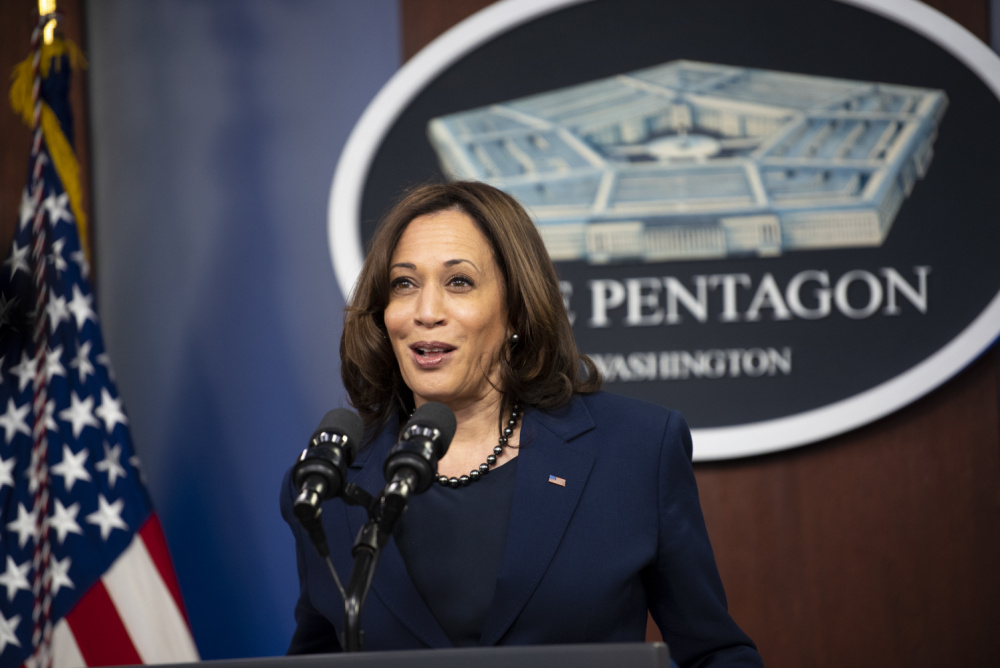
President Donald J. Trump delivers remarks during the 24th 9/11 Pentagon Observance Ceremony at the Pentagon, Washington, D.C., Sept. 11, 2025. Though the United States of America shares with other nations in a history of modern state militarism, the past 80 years following its consolidation as a world military power after World War II has seen a shift away from previous democratic characterizations of the state.  The last forty five years, with the rise of the neo-conservative Reagan and  Bush (2) administrations, began the abandonment of moral justifications for democracy building replaced by  bellicose proclamations of the need and right to move towards a national project of global security by preemptive military force. Even with the return of eight years of the, so called, Liberal Obama administrations we saw the further erosion of long held human right protections with the suspension of habeas corpus and the increased usage of extra-judicial drone bombing killings of claimed combatants in multiple conflicts worldwide. Again with Biden and now with the Trump administrations, these programs have increased unbeknownst to the general public as the mainstream media silenced and normalized perpetual wars including proxy wars in Israel and Venezuela.

In the process of global military expansion, the US population has been subjected to an internal re-education to accept the role of the U.S. as consolidating its hegemonic rule internationally in the interest of liberal ideals of wealth creation and protectionism.

U.S. Air Force airmen acting as extras during the filming of the 2007 film Transformers at Holloman Air Force Base. A camera operator on an ATV can be seen filming them on the right.The average citizen has slowly come to terms with stealthily increasing campaigns of militarization domestically in media offerings; from television, movies, militarized video games,  and scripted news networks to reinforce the inevitability of a re-configured society as security state. The effect has begun a transformation of how, as citizens, we understand our roles and viability as workers and families in relation to this security state. This new order has brought with it a shrinking public common and an increasing privatization of publicly held infrastructure; libraries, health clinics, schools and the expectation of diminished social benefits for the poor and middle-class. The national borders are being militarized as are our domestic police forces in the name of Homeland Security but largely in the interest of business. The rate and expansion of research and development for security industries and the government agencies that fund them, now represent the major growth sector of the U.S.economy. Additionally, as the U.S. economy continually shifts from productive capital to financial capital as the engine of growth for wealth creation and development, the corporate culture has seen its fortunes rise politically and its power over the public sector grow relatively unchallenged by a confused citizenry who are watching their social security and jobs diminishing.

Special Weapons and Tactics (SWAT) team members, some armed with assault rifles, preparing for an exerciseHow increasing cultural militarization effects our common future will likely manifest in increased public dissatisfaction with political leadership and economic strictures. Social movements within the peace community, like NNOMY, will need to expand their role of addressing the dangers of  militarists predating youth for military recruitment in school to giving more visibility to the additional dangers of the role of an influential militarized media, violent entertainment and play offerings effecting our youth in formation and a general increase and influence of the military complex in all aspects of our lives. We are confronted with a demand for a greater awareness of the inter-relationships of militarism in the entire landscape of domestic U.S. society.  Where once we could ignore the impacts of U.S. military adventurisms abroad, we are now faced with the transformation of our domestic comfort zone with the impacts of militarism in our day to day lives where we are witnessing militarized police forces in all our cities.

How this warning can be imparted in a meaningful way by a movement seeking to continue with the stated goals of counter-recruitment and public policy activism, and not loose itself in the process, will be the test for those activists, past and future, who take up the call to protect our youth from the cultural violence of militarism.

Counter-recruitment poster.The "militarization of US culture" category will be an archive of editorials and articles about the increasing dangers we face as a people from those who are invested in the business of war. This page will serve as a resource for the NNOMY community of activists and the movement they represent moving into the future. The arguments presented in this archive will offer important realizations for those who are receptive to NNOMY's message of protecting our youth, and thus our entire society, of the abuses militarism plays upon our hopes for a sustainable and truly democratic society.

NNOMY


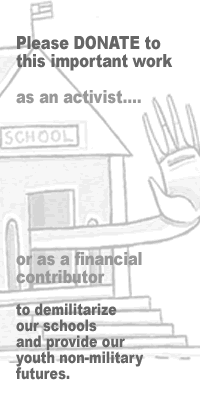
 Please consider becoming a supporter of The National Network Opposing the Militarization of Youth
And our work to demilitarize our schools and youth.
Donate Here


###

Revised / 10/29/2025 - GDG


The Resources section covers the following topics:


NNOMYpeace has organized the following resources for our own staff of activists to promote our campaigns on different social media platforms. Many are formatted for Facebook, Instagram, and Twitter feeds. 

We also welcome those activists inside our network of groups doing Truth in Recruitment and Counter-recruiting activism to utilize there resources for their own social media channels.

If you are not a group associated to NNOMYpeace, and would like to utilize these resources on your own channels, we encourage your groups to integrate to NNOMY on our National Directory of Youth Demilitarization Groups to help support the national community of youth demilitarization groups to know you and the scope of your activism. You can share your information to list your group by submitting an organizational form at the following LINK.

We have distributed the following graphics by campaign. Click on the categories below to see those that support different campaign themes by NNOMY

__________________________________________


The Divest “Your Body” from the War Machine graphics are campaigning resources for social media for the Divest campaign that NNOMY is collaborating with CodePink. NNOMY focuses on asking youth to "Divest of their Bodies" from military service with the war machine. These are strictly to be utilized with counter-recruitment only and not with TIR.

These social media resources are to be utilized with the "Winning the Peace" campaign in cooperation with the palm cards developed by War Resisters League and the support website created for smart phones, "What Everyone Should Know Before Joining the Military / Lo que deberías saber entres de enrolarte en las Fuerzas Armadas (FF.AA.) ,"  to answer questions for youth about what military service really involves for them.

These social media resources focus on groups nationally and regionally that take part in some form of youth demilitarization activism. That can include themes such as Truth in Recruitment or Counter-recruitment activism or participate in outreach to schools as veteral or antiwar speakers. Those using them should be cognizant of the limits that your location and context present before you decide to select the appropriate images and appeals for your use.

The Misc. social media image resources category are designed around various appeals encompassing general counter-recruitment messages and antiwar themes. They should be utilized judiciously with attention paid to the moment and situation of which they are applied. Some of these may be themed along specific important dates in the peace calendar of on specific subject relating to militarization especially those themes that effect youth. Those found in this category are not specific to a campaign.

Back to School Against War & Militarism! Get the 2018-19 Back-to-school Kit for Counter-recruiting and School De-militarization Organizing from The National Network Opposing the Militarization of Youth and find out how you can help keep our youth safer and send a message to school officials and your government... military recruiters should be monitored in local high school and minor-aged youth deserve a balanced narrative on military service! Act Now to activate in your child's public school against Pentagon intrusions into our community youth.

The "Eliminate Selective Service for Everyone" campaign category addresses the antiquated Selective Service system and the demand for its elimination. With the issue of women now being qualified for combat duties including fighting, the issue has been brought before the congress and senate of the United States to require women to register, like men, in the years when young adults are typically drafted into the services to fight wars if the draft needs to be re-initiated in the event of a national crisis where there are not sufficient troops to meet the troop requirement.

This campaign, "Eliminate Selective Service for Everyone," asks for the elimination of this demand based on it being a violation of basic and internationally recognized human rights protocols including the Universal Declaration of Human Rights.

https://nnomy.org/selectiveservice

The "Costs of War" campaign category came from the Watson Institute for International Affairs website of Brown University in Providence, RI. This institute has made their research into the economic, social, political, and human costs of U.S. wars their research focus. Their mission statement explains the following:

The Costs of War Project is a team of 50 scholars, legal experts, human rights practitioners, and physicians, which began its work in 2010. We use research and a public website to facilitate debate about the costs of the post-9/11 wars in Iraq and Afghanistan, and the related violence in Pakistan and Syria. There are many hidden or unacknowledged costs of the United States’ decision to respond to the 9/11 attacks with military force. We aim to foster democratic discussion of these wars by providing the fullest possible account of their human, economic, and political costs, and to foster better informed public policies.

This campaign, "Costs of War," asks for the public to be aware that our post 9/11 foreign policy has an effect on the U.S.'s international relations that are increasingly coming under question domestically and internationally and how those policies align with the stated goals of the U.S. State Department and its allied governments..

https://nnomy.org/costsofwar

NNOMY Peace produces workshops to assist groups in understanding the tactics of military recruiters in the school and the community and create community and strategies for groups envolved in youth demilitarization efforts.

NNOMYpeace produces printable and viewable resources to support the practice of Truth in Recruitment and Counter-recruitment activism.

News reports from the groups associated to the NNOMY Network including Social Media.

Reports from counter-recruitment groups and activists from the field. Includes information about action reports at recruiting centers and career fairs, school tabling, and actions in relation to school boards and state legislatures.

David SwansonDavid Swanson is the author of the new book, Daybreak: Undoing the Imperial Presidency and Forming a More Perfect Union, by Seven Stories Press and of the introduction to The 35 Articles of Impeachment and the Case for Prosecuting George W. Bush by Dennis Kucinich. In addition to cofounding AfterDowningStreet.org, he is the Washington director of Democrats.com and sits on the boards of a number of progressive organizations in Washington, DC.


Charlottesville Right Now: 11-10-11 David Swanson
David Swanson joins Coy to discuss Occupy Charlottesville, protesting Dick Cheney's visit to the University of Virginia, and his new book. -  Listen

Jorge MariscalJorge Mariscal is the grandson of Mexican immigrants and the son of a U.S. Marine who fought in World War II. He served in the U.S. Army in Vietnam and currently teaches at the University of California, San Diego.

Matt GuynnMatt Guynn plays the dual role of program director and coordinator for congregational organizing for On Earth Peace, building peace and nonviolence leadership within the 1000+ congregations of the Church of the Brethren across the United States and Puerto Rico. He previously served a co-coordinator of training for Christian Peacemaker Teams, serving as an unarmed accompanier with political refugees in Chiapas, Mexico, and offering or supporting trainings in the US and Mexico.

Rick Jahnkow

Rick Jahnkow has worked for two San Diego-based anti-militarist organizations, the Project on Youth and Non-Military Opportunities and the Committee Opposed to Militarism and the Draft. Rick Jahnkow, one of both organization’s founders, first became active organizing draft resistance and opposition to the Vietnam War. He can be reached at: This email address is being protected from spambots. You need JavaScript enabled to view it.

Counter-recruitment and school demilitarization work in the U.S. has gone through several cycles of expansion and contraction during the last few decades. The first expansion was during the early 1980s when it was supported by a small number of national organizations, such as the American Friends Service Committee (AFSC), War Resisters League, Central Committee for Conscientious Objectors (CCCO) and National Lawyers Guild. Most grassroots activities at the time were carried out by chapters of these organizations and a number of independent community peace groups (including COMD and, eventually, Project YANO).

Many counter-recruitment organizers in the 1980s came from the Vietnam-era anti-draft movement, so it was common for them to include draft counseling information as they also worked to counter the presence of military recruiters in schools. This dual emphasis was encouraged by the return of Selective Service registration in 1980 and the government’s various efforts to coerce young men into compliance. Frequently, organizers saw no distinction between the issues of recruiting and Selective Service registration, which had both positive and negative consequences. It was positive in the sense that fear of a possible return to the draft fueled more youth-focused organizing and helped increase awareness of recruiting and militarism in schools. But on the negative side, the frequent focus on Selective Service kept many activists from fully comprehending that economics had become the primary factor driving the militarization of young people, and that draft counseling was not an effective approach to the problem. Another negative consequence was that as concern about conscription diminished in the late 1980s, the overall level of counter-recruitment work also fell considerably.

Fortunately, those groups that did continue to organize deepened their analysis and developed more appropriate and effective organizing approaches. For example, they focused on addressing the “poverty draft” by compiling and distributing literature on alternatives to enlistment. At the same time, they sought to either eliminate recruiters from schools or at least secure equal access to give students alternative information. As the tactics evolved and improved, there were a number of important achievements. For example:


The principle of equal school access for counter-recruiters was realized in many places, thanks to a combination of effective organizing and a few successful lawsuits decided in the late 1980s. The broadest legal precedent for equal access came in a 1986 ruling won by COMD in the federal Ninth Circuit Court of Appeals.


  • Solid research produced high-quality tools for grassroots organizing, including a professionally produced slide show that eventually evolved into a powerful educational DVD, “Before You Enlist,” which is used widely today.
  • In many places, school policies were passed that severely curtailed, or completely banned, recruiter access to students.
  • Opportunities for successful cross-community and cross-issue organizing developed that had not been available to the traditional U.S. antiwar movement.

Read More


Media:

Publications:

Group affiliations:

Special Collections & University Archives:

  • Committee Opposed to Militarism and the Draft Records
    1979-2021 Bulk: 1980-1987
    http://scua.library.umass.edu › category › social-change › draft-resistan…
    Draft resistance – Special Collections & University Archives
    Formed in 1979 in the wake of a congressional vote on reinstating the draft, the Committee Opposed to Militarism and the Draft (COMD) was formed by San Diego-based anti-war activists Bill Roe, Hoppy Chandler, Norm Lewis, Fritz Sands, and Rick Jahnkow.

    ###


Pat ElderPat Elder was a co-founder of the DC Antiwar Network (DAWN) and a member of the Steering Committee of the National Network Opposing the Militarization of Youth, (NNOMY).  Pat is currently involved in a national campaign with the Women's International League for Peace & Freedom project, Military Poisons,  investigating on U.S. military base contamination domestically and internationally.  Pat’s work has prominently appeared in NSA documents tracking domestic peace groups.


Documents:

audio  Pat Elder - National Network Opposing the Militarization of Youth

NNOMY periodically participates in or organizes events(e.i. conferences, rallies) with other organizations.

News articles reposted about NNOMY. Includes news reports about our work with associated groups and conferences.

The Counter-recruitment Essentials section of the NNOMY web site covers the issues and actions spanning this type of activism. Bridging the difficult chasms between religious, veteran, educator, student, and community based activism is no small task. In this section you will find information on how to engage in CR activism in your school and community with the support of the knowledge of others who have been working to inform youth considering enlisting in the military. You will also find resources for those already in the military that are looking for some guidance on how to actively resist injustices  as a soldier or how to choose a path as a conscientious objector.

John Judge was a co-founder of the Committee for High School Options and Information on Careers, Education and Self-Improvement (CHOICES) in Washington DC, an organization engaged since 1985 in countering military recruitment in DC area high schools and educating young people about their options with regard to the military. Beginning with the war in Viet Nam, Judge was a life-long anti-war activist and tireless supporter of active-duty soldiers and veterans.


"It is our view that military enlistment puts youth, especially African American youth, at special risk, not only for combat duty, injury and fatality, but for military discipline and less than honorable discharge, which can ruin their chances for employment once they get out. There are other options available to them."


In the 1970's the Selective Service System and the paper draft became unworkable, requiring four induction orders to get one report. Boards  were under siege by anti-war and anti-draft forces, resistance of many kinds was rampant. The lottery system failed to dampen the dissent, since people who knew they were going to be drafted ahead of time became all the more active. Local draft board members quit in such numbers that even I was approached, as a knowledgeable draft counselor to join the board. I refused on the grounds that I could never vote anyone 1-A or eligible to go since I opposed conscription and the war.

At this point the Pentagon decided to replace the paper draft with a poverty draft, based on economic incentive and coercion. It has been working since then to draw in between 200-400,000 enlisted members annually. Soon after, they began to recruit larger numbers of women to "do the jobs men don't want to". Currently recruitment quotas are falling short, especially in Black communities, and reluctant parents are seen as part of the problem. The hidden problem is retention, since the military would have quadrupled by this time at that rate of enlistment, but the percentage who never finish their first time of enlistment drop out at a staggering rate.

I began bringing veterans of the Vietnam War into high schools in Dayton, Ohio in the late 1960s, and have continued since then to expose young people to the realities of military life, the recruiters' false claims and the risks in combat or out. I did it first through Vietnam Veterans Against the War/Winter Soldier Organization, then Dayton Draft & Military Counseling, and since 1985 in DC through C.H.O.I.C.E.S.

The key is to address the broader issues of militarization of the schools and privacy rights for students in community forums and at meetings of the school board and city council. Good counter-recruitment also provides alternatives in the civilian sector to help the poor and people of color, who are the first targets of the poverty draft, to find ways to break into the job market, go to a trade school, join an apprenticeship program, get job skills and placement help, and find money for college without enlisting in the military.

John Judge -- counselor, C.H.O.I.C.E.S.
 
Articles
References:
Videos
Tributes

###


https://nnomy.org/popcultureandmilitarism/

Selene Rivas presents for the International Week of Action Against the Militarisation of Youth a series of brief articles exploring how the U.S. citizenry has been normalized to accept a permanent state of militarism through popular culture: Movies, video games and comic books. From Monday, November 20th and continuing through Sunday the 26th of November, 2017, a new segment of this series of short articles will be featured each day. Select from the articles below.

You can find out more about the Week Of Action at War Resisters' International.

 https://nnomy.org/edwardhasbrouck

Edward Hasbrouck grew up in Wellesley, Massachusetts, a suburb of Boston. He considers myself primarily a political activist. Hasbrouck began his resistance to the violence of illegitimate authority as an elected but nonvoting student representative to the local school board and as an activist for peace, disarmament, and students' rights. His first book was a handbook for high school students on their legal rights co-authored in the summer of 1977, between high school and college, as an intern for the student service bureau of the Massachusetts Department of Education. He majored in political science at the University of Chicago until leaving school to pursue direct involvement in political activism.


Conscription of young people to fight old people's wars is one of the ultimate expressions of ageism, and for me, resistance to an ageist draft was first and foremost a component and continuation of the struggle for youth liberation. The religious and authoritarian justifications for conscription and war are remarkably similar to the religious and authoritarian rationales for violence against children and for slavery. - Edward Hasbrouck


In 1980, after a five-year hiatus, the U.S. government reinstated the requirement that all young men register for military conscription with the Selective Service System. In 1982, Hasbrouck was selected for criminal prosecution by the U.S. Department of "Justice" (specifically, by William Weld and Robert Mueller) as one of the people they considered the most vocal of the several million nonregistrants for the draft. As one of 20 nonregistrants who were prosecuted before the government abandoned the enforcement of draft registration, Hasbrouck was convicted and "served" four and a half months in a Federal Prison Camp in 1983-1984. The high-profile trials of resistance organizers proved counterproductive for the government. These trials served only to call attention to the government's inability to prosecute more than a token number of nonregistrants, and reassured nonregistrants that they were not alone in their resistance and were in no danger of prosecution unless they called attention to themselves.


Articles:

Resources:


###


NNOMY is Funded by

© 2025 Your Company. Designed By JoomShaper


Gonate time or money to demilitarize our public schools

FAIR USE NOTICE

FAIR USE NOTICE

This site contains copyrighted material the use of which has not always been specifically authorized by the copyright owner. We are making such material available in our efforts to advance understanding of issues connected with militarism and resistance. We believe this constitutes a ‘fair use’ of any such copyrighted material as provided for in section 107 of the US Copyright Law. In accordance with Title 17 U.S.C. Section 107, the material on this site is distributed without profit to those who have expressed a prior interest in receiving the included information for research and educational purposes. For more information go to: https://www.law.cornell.edu/uscode/17/107.shtml. If you wish to use copyrighted material from this site for purposes of your own that go beyond ‘fair use’, you must obtain permission from the copyright owner.

Contact NNOMY

NNOMY

The National Network Opposing

the Militarization of youth
San Diego Peace Campus

3850 Westgate Place
San Diego, California 92105 U.S.A.
admin@nnomy.org  +1 619 798-8335
Tuesdays & Thursdays 12 Noon till 5pm PST
NNOMY Volunteer and Internship Inquiries